Defense Manufacturing Becomes the Frontline
Defense manufacturing just became the hottest bet in venture capital. Hadrian raised $1.37 billion at a $7.87 billion valuation, and the Torrance, California startup does not build missiles, drones, or submarines. It builds the highly automated factories that make the parts inside them, and investors have decided this unglamorous corner of defense manufacturing may be the most valuable real estate in the entire national security economy.
The Series D, announced on August 6, was co-led by WCM Investment Management, Washington Harbour Partners, Valor Equity Partners, 137 Ventures, and Baillie Gifford, with JPMorgan Chase's Strategic Investment Group anchoring as co-lead. Andreessen Horowitz, Founders Fund, and Lux Capital piled back in. The raise more than quadrupled Hadrian's valuation since January, a repricing that tells you how quickly capital has swung toward the physical layer of American defense manufacturing.
"Production is now the frontline of deterrence," founder and chief executive Chris Power said in announcing the round. It is a deliberately provocative line, and it captures the thesis cleanly. The next war, in this view, will not be won by whoever designs the cleverest weapon. It will be won by whoever can build enough of them, fast enough, when the shooting starts.
The Software Beneath the Steel
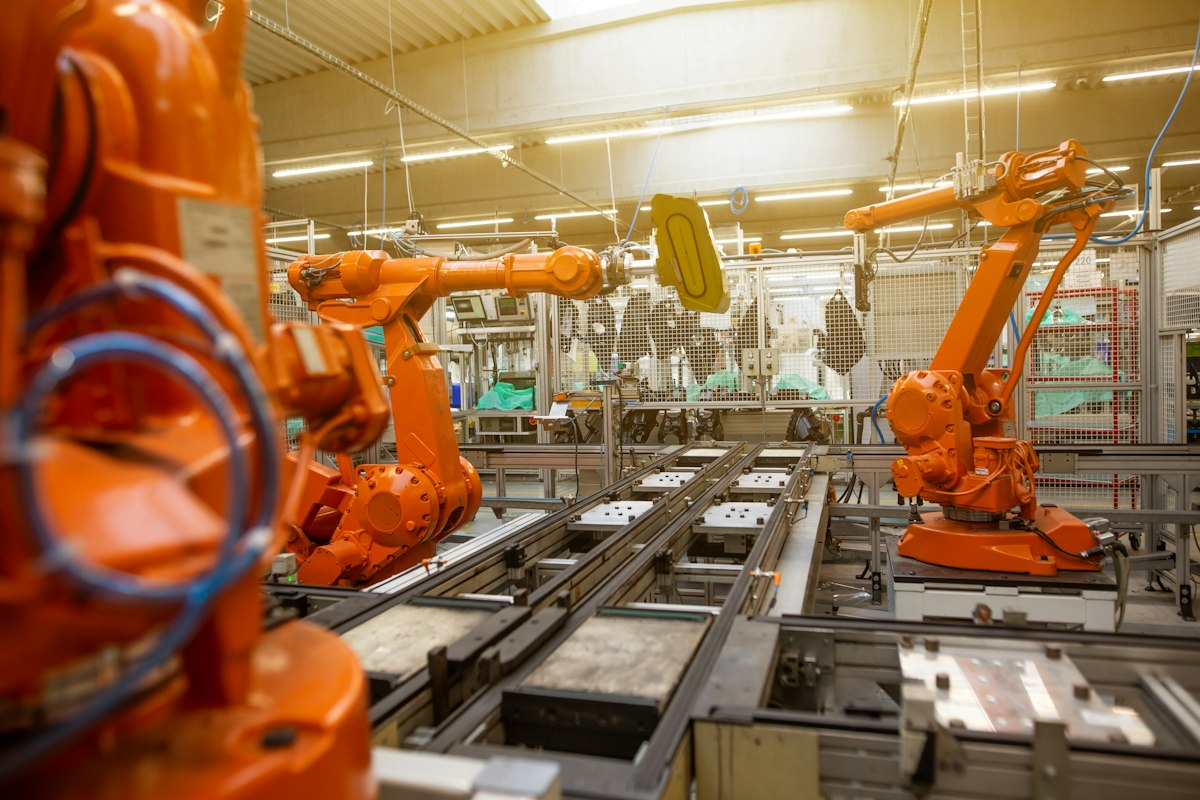
Hadrian's pitch rests on a piece of software called Opus, a platform that runs its factories the way an operating system runs a computer. Rather than staffing a plant with hundreds of specialized machinists, Hadrian pairs robotics and CNC machining with software that schedules jobs, controls tolerances, tracks quality, and lets a smaller, less specialized workforce operate highly complex production lines. Power says Opus is already in use by the U.S. Army and Navy, with additional prime contractors expected to be named.
The strategic wager is that defense manufacturing has been strangled for decades by a labor and tooling model that does not scale. A single qualified machinist can take years to train, and the average age of the American manufacturing workforce keeps climbing. Every retirement removes capacity that cannot be quickly replaced. Software-defined factories are Hadrian's attempt to break that constraint by encoding expertise into the system itself, so that output is limited by machines and floor space rather than by the shrinking pool of veteran tradespeople.
Power frames this as part of a larger shift. "With physical AI sweeping the physical economy, which is 100 times larger than the digital economy, everyone's going to need to rebase their software to adapt and compete in this new world," he told CNBC. Whether or not the 100x figure survives scrutiny, the direction of travel is real. The same investors who spent five years funding chatbots are now hunting for AI that moves metal, and defense manufacturing sits at the center of that pivot.
Silicon Valley Writes Much Bigger Checks
Hadrian's round does not exist in isolation. It is the latest and one of the largest entries in a defense-tech financing wave that has turned a niche category into a collection of the most valuable private companies in America. Palmer Luckey's Anduril Industries raised $2.5 billion at a $30.5 billion valuation, then saw that figure climb past $60 billion within two months. Shield AI, which builds autonomous aircraft, was valued at $12.7 billion earlier this year. Autonomous shipbuilder Saronic reached $9.25 billion. Hadrian's leap from roughly $1.8 billion in January to $7.87 billion now fits the pattern precisely.
What makes Hadrian distinct is where it sits in the stack. Anduril, Shield AI, and Saronic design finished weapons systems. Hadrian builds the industrial capacity underneath all of them. Every autonomous drone, every attack submarine, every precision munition still has to be machined, assembled, and shipped from a physical plant. By investing in the factory rather than the product, backers are betting that manufacturing capacity itself has become strategic technology, valued almost as aggressively as the weapons it produces.
That is a meaningful shift in how Wall Street and Silicon Valley read the defense manufacturing landscape. For most of the modern era, the industrial base was treated as a cost center, a low-margin necessity dominated by a handful of prime contractors. The current wave of capital treats it as a scarce, defensible asset, and the valuations reflect that reappraisal.
Why the Arsenal Is Running Dry
The urgency behind these numbers is not abstract. The wars in Ukraine and the Middle East, along with rising tension in the Indo-Pacific, have exposed how thin American production capacity has become. Munitions stockpiles have been drawn down faster than factories can refill them. Shipyards struggle to keep pace with the Navy's demand for Columbia- and Virginia-class submarines, a bottleneck Hadrian has targeted directly with a dedicated facility in Cherokee, Alabama. The drone industrial base, critical to modern warfare, remains heavily dependent on foreign components.
The Trump administration is pushing defense spending toward $1.5 trillion, a figure that only intensifies the pressure. More money does not automatically produce more submarines or more artillery shells if the factories, tooling, and skilled workers do not exist to absorb it. That is the gap Hadrian is built to close, and it is why defense manufacturing capacity has become a policy obsession as much as an investment thesis. Deterrence depends not just on having advanced weapons on paper, but on being able to produce them at volume and replace them under wartime attrition.
This is the quieter story inside the defense-tech boom. The headline-grabbing money has flowed to autonomous systems and AI-enabled weapons. The harder problem, and arguably the more decisive one, is manufacturing enough of everything. A drone that cannot be mass-produced is a demonstration, not a deterrent.
The Bet, and Its Risks
For all the momentum, a $7.87 billion valuation carries real weight. Hadrian must now prove that software-defined factories can scale across many sites and product lines without the quality failures that plague complex manufacturing. Defense customers are demanding, certification cycles are long, and a single production defect in a mission-critical part can unwind years of trust. The company is effectively promising to do for factories what cloud computing did for servers, and that transformation is far from guaranteed.
There is also the question of concentration. Much of the defense manufacturing renaissance is being financed by the same cluster of venture firms and crossover investors, at valuations that assume sustained government demand and a permanent shift in procurement culture. Budgets can tighten, administrations change, and the Pentagon's willingness to route work through venture-backed newcomers rather than entrenched primes is still being tested. A slowdown in any of those variables would land hard on the richest valuations.
Still, the direction is unmistakable. Investors have concluded that the constraint on American power is no longer only invention but production, and they are pricing defense manufacturing accordingly. Hadrian's $1.37 billion round is a wager that the factory, not the weapon, is the scarce resource of the next decade. For more coverage of the industrial and AI economy, visit Blumefield. If Chris Power is right that production is the new frontline, the companies building the frontline itself may prove to be the most strategic bet of all.