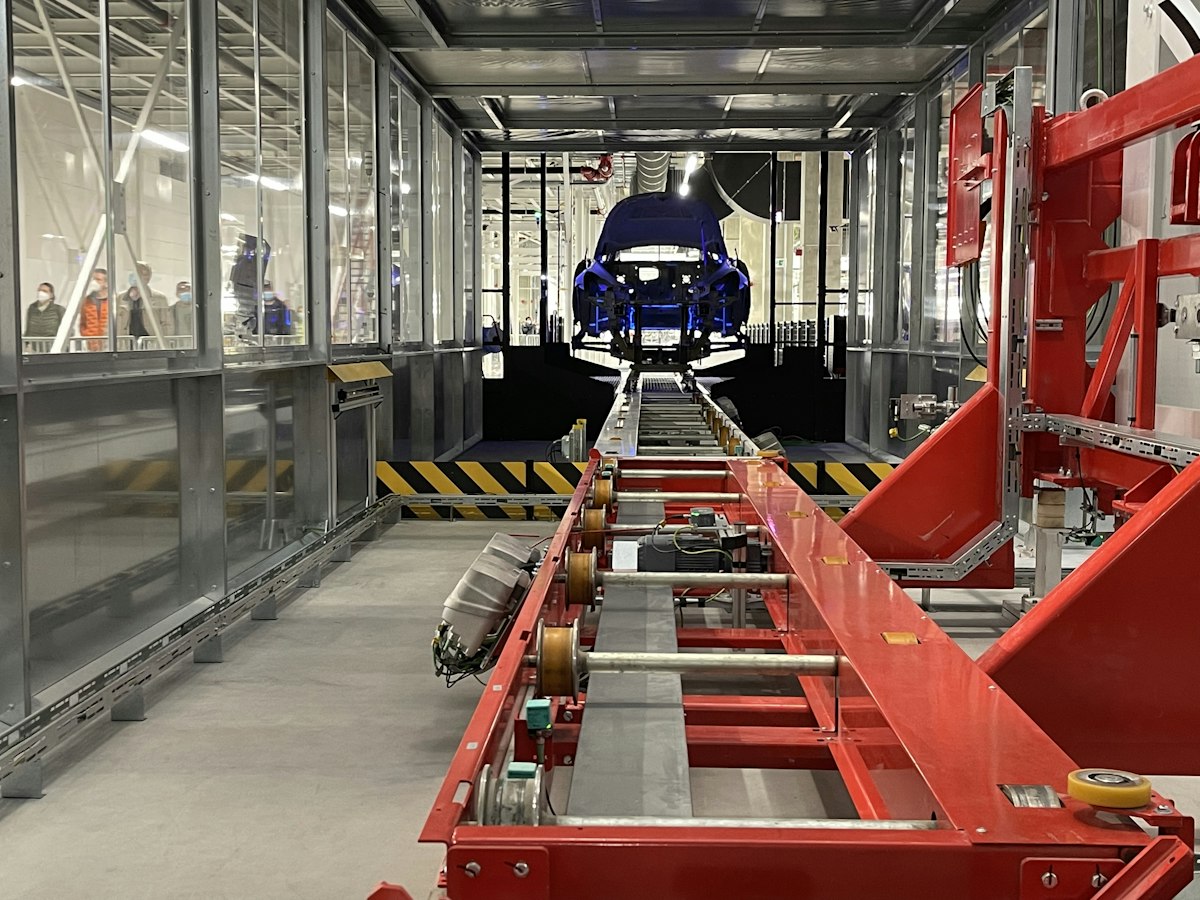
The headline number in the Tesla Q3 earnings looked almost reassuring. Revenue of roughly $28.05 billion came in flat against the same quarter last year, matched Wall Street's consensus to within a rounding error, and kept Tesla's trailing twelve-month sales above $100 billion for a second straight quarter. Yet beneath that steadiness, the Tesla Q3 earnings told a far more consequential story, one of a carmaker deliberately spending its profits away in pursuit of something it no longer wants to be judged as.
By Blumefield | October 22, 2026
A Record Top Line Hiding a Shrinking Bottom Line
For a company that spent much of 2025 fending off talk of a demand collapse, a flat top line alone counts as a result. The trouble sits one line down. GAAP net income landed at $787 million, down roughly 43 percent from $1.37 billion a year earlier. Income from operations fell even harder, sinking 56 percent to $718 million and dragging the operating margin down to 2.6 percent from 5.8 percent. Diluted earnings came in at $0.22 a share against $0.39 in the prior year. The one bright spot for traders was non-GAAP EPS of $0.48, which edged past the $0.45 analysts expected and sent the stock higher in after-hours trading.
Vehicle deliveries told their own quiet story: 486,532 cars, down about 2 percent, even as production rose 4 percent and inventory shrank to eleven days of supply. Tesla blamed battery availability rather than weak demand, and it pointed to a passenger-vehicle backlog at its largest in four years. Whatever the cause, the Tesla Q3 earnings confirm that the core car business is no longer the growth engine it once was.
Where the Profit Actually Went
A 56 percent collapse in operating income usually signals a business in trouble. In the Tesla Q3 earnings, it signals a decision instead. Operating expenses jumped 39 percent to $4.78 billion, led by a 69 percent surge in research and development spending to $2.76 billion. Stock-based compensation nearly doubled to $1.17 billion, reflecting the enormous 2025 pay package handed to Elon Musk. The money Tesla used to drop to the bottom line is now being poured into things that do not yet sell.
What makes the quarter genuinely interesting is that the underlying car economics improved while profit fell. Total gross margin rebounded to 19.6 percent from 18.0 percent a year ago and just 16.8 percent in the prior quarter. Automotive gross margin excluding regulatory credits climbed to 18.1 percent, helped by better regional and product mix and a growing stream of high-margin software revenue. That recovery is notable because it happened despite regulatory credit income cratering 73 percent to $113 million as the policy tailwinds that once padded Tesla's results continue to fade.
In other words, the car company got healthier even as the corporation got less profitable. That paradox sits at the heart of these Tesla Q3 earnings. Management is treating hardware margins as a funding source rather than a destination, and it said as much, telling shareholders it expects hardware-related profits to be accompanied by an acceleration of its software, fleet, and artificial intelligence businesses over time.
The Robotaxi and Optimus Wager
Nowhere is the spending more visible than in autonomy and robotics. Active Full Self-Driving subscriptions reached 1.74 million, up 67 percent, and Tesla said the FSD attach rate exceeded 75 percent of new vehicle deliveries in North America. Software, not sheet metal, is increasingly what customers are paying extra for, and it carries margins a factory can only envy.
The robotaxi program is scaling, though from a tiny base. Cumulative unsupervised miles approached two million by quarter end, an eightfold jump from the prior quarter, after Cybercab vehicles joined the Austin fleet in early September. On the call Musk framed the ambition in characteristically sweeping terms, saying Tesla intends to "take over any kind of transportation" and that, unless it is stopped by government, the company will one day carry most passenger miles. He also conceded the unit economics are not there yet, admitting Tesla has not reached its target of thirty cents per mile but sees a path toward that goal.
Optimus, the humanoid robot Musk insists "will be the biggest product on Earth," has begun production in Fremont. Here the tone was unusually measured. Musk described Optimus growth as an S-curve whose left side is "shallow and slow," said he wanted to temper expectations, and pushed meaningful external deliveries out to the end of 2027. Consumer unsupervised FSD slipped to the second quarter of 2027, and the Texas chip fab Musk calls Terrafab will not reach real production until late 2028. The vision is vast. The timelines keep moving to the right.
Energy and Cash Provide the Ballast
While cars and robots grabbed attention, the steadier numbers came from two less glamorous corners. Services and other revenue grew 33 percent to $4.61 billion and produced a record gross profit of $734 million from charging, insurance, and parts, a reminder that Tesla's installed base is itself becoming an annuity. The energy division saw revenue fall 16 percent to $2.88 billion, partly because of tariff-related customer refunds, yet its gross margin expanded dramatically to 33 percent from 20 percent. Tesla said energy storage orders and backlog hit record highs, its Texas megafactory began production toward a planned 50 gigawatt-hours of annual capacity, and the first Megapacks using domestically made LFP cells started shipping from Nevada.
Cash generation, however, weakened. Free cash flow of $1.53 billion compared with nearly $4 billion a year ago, flattered by capital spending that eased to $4.73 billion from the prior quarter's level. Tesla ended September with $45.4 billion in cash and investments, up $1.9 billion sequentially. Management trimmed full-year capital expenditure guidance toward $20 billion and said it would lean on a planned $30 billion of shorter-term debt funding. For a company that long prided itself on self-funding, a growing appetite for debt is its own kind of signal about the scale of what lies ahead.
What Investors Are Really Buying
Strip away the quarter-to-quarter noise and the Tesla Q3 earnings pose a single uncomfortable question. Investors are valuing Tesla as an artificial intelligence and robotics company worth more than a trillion dollars, yet the financial statements still describe a maturing automaker reinvesting its profits into bets that may not pay off for years. The bull case says those bets, from robotaxis to humanoids to grid-scale storage, justify today's price many times over. The bear case notes that every one of those bets just had its delivery date pushed further out.
The rebound in automotive margins gives Musk room to keep spending without a cash crisis, and the surging FSD and services revenue hint at the software-driven model he keeps promising. But the Tesla Q3 earnings also lay bare the cost of that transition in plain numbers: profit down more than 40 percent, operating income more than halved, and a research budget that now rivals the earnings it consumes. The company is asking shareholders to look past the income statement toward a future it has not yet built.
For now, Tesla is earning the benefit of the doubt, as the after-hours pop suggested. Whether these Tesla Q3 earnings mark the bottom of a deliberate investment cycle or the start of a longer squeeze depends entirely on execution against timelines that have a habit of slipping. Readers tracking how this reinvestment wager unfolds can follow continuing coverage at Blumefield, where we examine the companies rewriting the boundary between hardware and software.
Investors will get their next read when the robotaxi fleet expands and Optimus leaves the factory floor. Until then, the market is buying a story, and Tesla just spent a large share of its profit to keep telling it. The full results and shareholder deck are available through Tesla's investor relations site, the company's third-quarter regulatory filing, and the product roadmap detailed at Tesla. For broader market context, see our ongoing analysis at Blumefield.