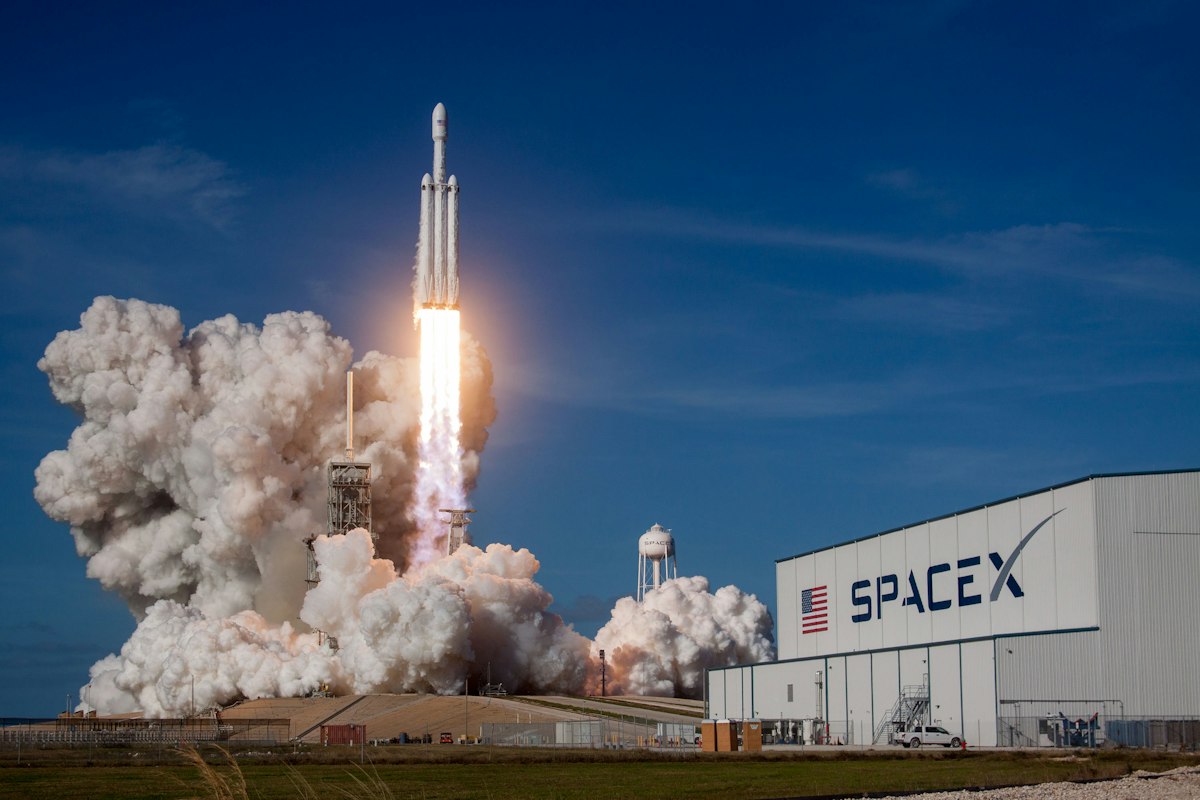
The first orbital Starship catch, the most consequential moment in rocketry since the maiden Falcon 9 landing, lasted about four seconds. At roughly 4:20 p.m. Eastern on Saturday, a stainless steel Starship upper stage dropped out of the Texas sky, decelerated into a hover beside its launch tower at Starbase, and settled into two mechanical arms that closed around it like a giant pair of chopsticks. It was a maneuver SpaceX engineers had rehearsed in simulation for years and never once attempted with a ship, and it worked on the first try.
A Spacecraft Snatched From the Fire
"That was the holy grail of space flight, plummeting through fire to be snatched out of the air by steel," SpaceX commentator Dan Huot said on the company webcast moments after the vehicle came to rest. "We caught a Starship, and now everything changes." A colleague on the stream called it the missing link. The language was grandiose, and for once it was close to earned.
The flight began the previous evening. Ship 42 lifted off from Starbase at 5:47 p.m. Eastern on November 13 atop Super Heavy Booster 22, reached orbit around 26 minutes later, and released all 26 of its Starlink V3 satellites within the first hour and 17 minutes. It then coasted for roughly 22 hours across about 14 orbits at an altitude near 275 kilometers before a short deorbit burn sent it screaming back through the atmosphere toward the Starship catch. You can read SpaceX's own account of the mission on its flight page.
The Booster That Got Away
This was supposed to be a clean sweep. SpaceX had billed Flight 15 as the first attempt at a double catch, with both the booster and the ship returning to the pad on the same mission. Only half of that happened.
Booster 22 separated, started its boostback burn, and then aborted the catch on its own. SpaceX's account shifted over two days. Huot initially pointed to a guidance, navigation and control issue, then clarified a day later that the system "performed as expected" and had simply detected that the booster "was not in the place that it was supposed to be to proceed with a catch" before triggering an automated abort. Engineer Kate Tice added that early indications showed the boostback burn ended early because of a low fuel mass alarm. The booster came down in the Gulf of Mexico and was lost, with the company still investigating the root cause.
That stings, but it stings far less than it would have a year ago. SpaceX has caught Super Heavy boosters before, on Flights 5, 7 and 8, so the hardware and the choreography are not new. The ship was the unproven prize, and the orbital Starship catch is the part that matters most.
Why the Catch Beats the Landing
To understand why an aborted booster barely dented the celebration, you have to understand what makes the Starship catch so much harder than anything SpaceX has done to date. A Falcon 9 first stage peels away at a few thousand kilometers per hour and comes home on landing legs. The Starship upper stage returns from orbital velocity, close to 27,000 kilometers per hour, and has to survive peak heating that turns its belly into a sheath of plasma before it can even think about a controlled descent. Catching it afterward, with no legs and no margin, is the engineering equivalent of threading a needle while the needle is on fire.
Pulling that off proves three things at once: that the heat shield holds, that the guidance can place a 50 meter vehicle within centimeters of a fixed tower, and that the catch itself scales from booster to ship. Landing legs add dead weight and demand a landing site, a pad, and a crew to retrieve the vehicle. A tower catch puts the ship back on its launch mount, where it can in principle be inspected, refueled and reflown. That is the whole premise of full and rapid reusability, and until Saturday it was a slide in a presentation rather than a thing that had happened.
The economic stakes are enormous. SpaceX has argued for a decade that if both stages fly again and again with minimal refurbishment, the marginal cost of reaching orbit collapses toward the price of propellant. A successful orbital Starship catch is the first real evidence that the second stage, the piece everyone else throws away, can be recovered intact. Cost per kilogram to orbit has already fallen by orders of magnitude in the Falcon era. This points at another step down, and the firms and agencies that built their plans around expendable rockets now have a genuine problem.
The Starlink Engine Behind It
None of this is happening for its own sake. Starship exists in large part to feed Starlink, and Starlink exists to pay for everything else. The V3 satellites deployed on this flight are the reason the ship had to grow so big in the first place. Each one is designed to deliver on the order of one terabit per second of downlink capacity, roughly ten times what the current V2 mini units manage, with gigabit speeds and direct-to-device connectivity in the roadmap. They are too large and too heavy to ride a Falcon 9 in any sensible number, which is exactly why they were waiting on Starship.
Flight 14 in late September deployed the first batch of 26 V3 craft, and Flight 15 added another 26 to a constellation that already numbers around 11,000 active satellites, as we detailed in earlier Blumefield reporting. Every reusable flight lowers the cost of flooding low Earth orbit with this far more capable hardware, which widens Starlink's bandwidth lead, which deepens the revenue stream that underwrites the Mars ambition. The orbital Starship catch is the mechanism that makes the flywheel spin faster. It is not a stunt. It is the unlock for a manufacturing and deployment pipeline that no rival has come close to matching.
The Widening Gap
Consider the timing. In the same news cycle that SpaceX executed its first orbital Starship catch, United Launch Alliance was preparing a return-to-flight of its Vulcan rocket carrying 40 satellites for Amazon's rival constellation, now marketed as Leo. Amazon has a few hundred satellites in orbit against Starlink's roughly 11,000, and it is leaning on an expendable vehicle to close that gap one modest batch at a time. Blue Origin, meanwhile, has stepped back from NASA's commercial space station competition. The contrast is hard to miss.
The gap SpaceX just opened is structural rather than cosmetic. No other operator flies a reusable heavy-lift vehicle at all, let alone one that can pull off a Starship catch and set the orbital stage back on the pad. Regulators and competitors have spent years assuming they had time to catch up while Starship worked through its failures in public. Saturday suggests the window is narrowing fast.
Plenty of work remains. SpaceX still has to diagnose the booster abort, repeat the Starship catch to show it was not a fluke, demonstrate on-orbit propellant transfer, and eventually turn Starship into the lander NASA is counting on for its return to the Moon. For more on the buildout funding all of this, see our continuing coverage at Blumefield. But the hardest single thing on the list just got crossed off. A spacecraft fell back from orbit, flew through fire, and was caught by a machine waiting to fly it again. As the man on the webcast said, now everything changes.
By Blumefield | November 15, 2026