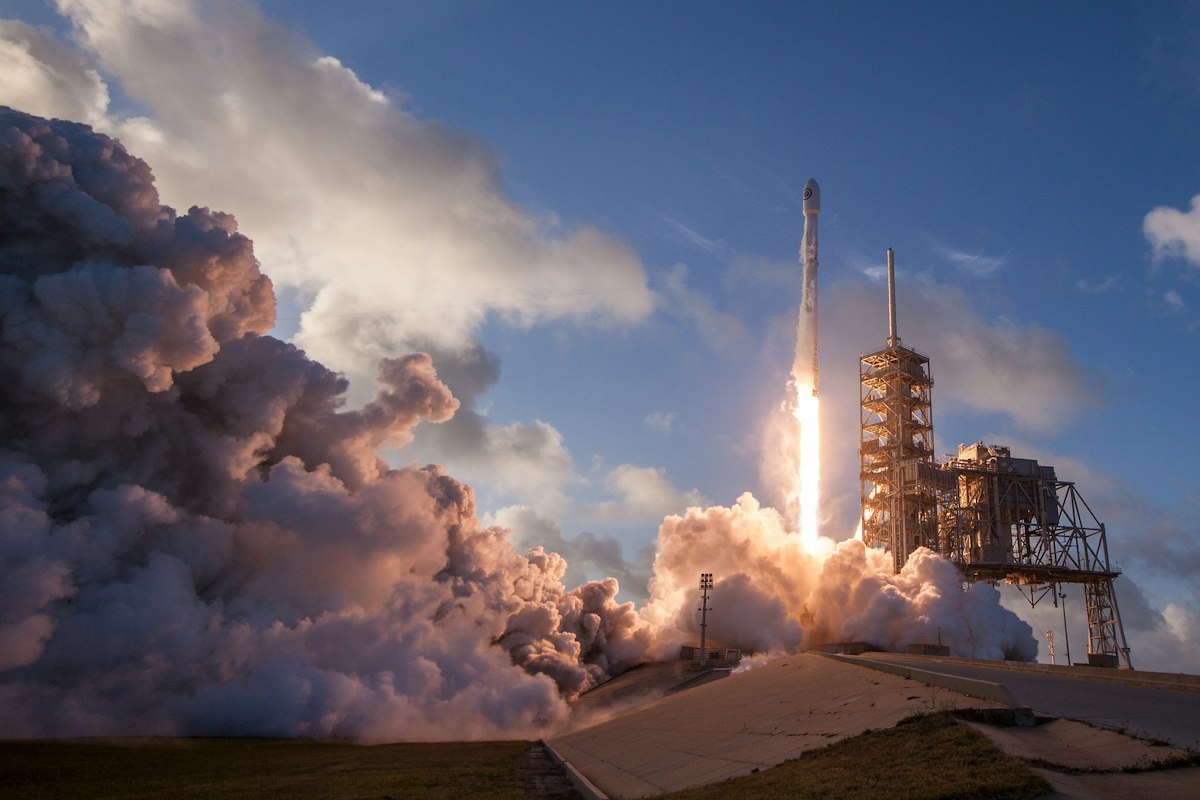
The largest IPO in history is about to become a forced purchase for millions of retirement accounts. When SpaceX joins the Nasdaq-100 on July 7, index funds have no choice but to buy, whether their managers like it or not. The SpaceX Nasdaq-100 inclusion is the clearest test yet of who really controls a passive market.
By Blumefield | July 6, 2026
The Fastest Ticket Into the Index
Twenty six trading days. That is roughly how long it took SpaceX to go from a private company with no public shares to a permanent fixture in the world's most watched growth index. The SpaceX Nasdaq-100 inclusion, effective before the opening bell on July 7, is happening under a fast track rule that lets certain blockbuster IPOs skip the usual seasoning period and enter the index after just fifteen trading days. Under the old regime, a newly listed company would have waited months, sometimes more than a year, before it qualified.
SpaceX earned that ticket the hard way. It priced its offering at $135 a share on June 11, raised roughly $75 billion, and stepped onto the Nasdaq under the ticker SPCX with a valuation near $1.77 trillion. SpaceX is now one of the most valuable companies in America. That eclipsed Saudi Aramco's 2019 debut and made SpaceX the largest public offering ever recorded. Shares jumped about 19 percent on the first day, briefly pushing the company's market capitalisation above $2 trillion and peaking at $225.64 intraday on June 16 before cooling toward the low $150s by late June.
Size alone did not guarantee entry. The Nasdaq-100 tracks the hundred largest non financial companies on the exchange, and SpaceX's sheer scale vaulted it past the threshold immediately. What the fast track rule changed was the calendar. The SpaceX Nasdaq-100 inclusion arrived in weeks rather than months, and every fund built to mirror the index now has to catch up in a single session.
Why Passive Money Has No Choice
Here is the mechanical reality that makes this event so unusual. An index fund does not get to have an opinion. The Nasdaq-100 inclusion is not optional for the vehicles that track the benchmark. When SpaceX enters, funds such as Invesco's QQQ are contractually obligated to hold it at its assigned weight, and they must do the buying by the close of July 6 so their portfolios match the benchmark when trading opens the next morning. Estimates put QQQ's required purchase alone at around $4.3 billion. Across the broader universe of Nasdaq-100 trackers and overlapping Russell 1000 reweightings, near term mechanical buying runs somewhere between $22 billion and $27 billion.
The twist is that SpaceX will enter with a relatively modest weighting, likely between 0.5 and 1 percent. That seems small for a company worth well over a trillion dollars, and the reason is float. The Nasdaq-100 weights its members by free float market capitalisation, which strips out insider holdings and restricted stock. Elon Musk and a tight group of early backers still control the overwhelming majority of SpaceX shares, so only a thin slice actually trades. That thin float is precisely what turns a small index weight into an outsized market event, because billions of dollars in forced demand are chasing a limited supply of available stock.
For ordinary savers, this is not an abstraction. Anyone with a workplace retirement plan, a target date fund, or a plain Nasdaq-100 tracker is about to own a piece of SpaceX without ever placing a trade. The SpaceX Nasdaq-100 inclusion quietly rewrites the holdings of millions of accounts overnight.
The Great Reshuffle Nobody Voted For
Adding a new name to a fixed index does not create fresh money. It redistributes it. To fund the SpaceX purchase that the Nasdaq-100 inclusion demands, every tracker has to sell proportional slices of what it already owns, and the largest constituents feel it most. Apple, Nvidia, Microsoft, Amazon, Alphabet, Meta, and Broadcom will each be trimmed slightly so the new arrival can take its seat.
That reshuffle lands at an interesting moment. The Dow Jones Industrial Average crossed 53,000 for the first time on July 6 as markets returned from the Independence Day holiday, and the S&P 500 climbed about 0.68 percent. Yet beneath the record headlines, AI semiconductor names have been volatile, with Micron, AMD, and Intel all selling off sharply in recent sessions. Into that churn steps a mandatory rebalance that pulls capital out of the very megacaps that carried the market to its highs and parks it in a company that has been public for less than a month.
None of this reflects a judgment about SpaceX's business. The selling of Apple and Nvidia shares is not a vote of no confidence, and the buying of SpaceX is not a vote of enthusiasm. It is arithmetic. That is the strange power of passive investing at scale, where the composition of an index can move tens of billions of dollars on a schedule that has nothing to do with fundamentals.
What History Says Happens Next
Investors hoping the SpaceX Nasdaq-100 inclusion guarantees a pop should study the record more carefully. History suggests the opposite is often true. Forced index buying tends to pull demand forward, so much of the upside gets priced in during the weeks before the effective date, as traders position ahead of the funds that are compelled to buy. Once the mechanical purchasing is done, that engineered demand disappears, and stocks frequently drift lower in the sessions that follow. That is the paradox of a Nasdaq-100 inclusion built on forced buying.
SpaceX already shows the fingerprints of that dynamic. The stock ran to its June 16 peak on debut euphoria and anticipation, then gave back ground over several consecutive sessions. If the historical pattern holds, the days immediately after July 7 could bring a fade rather than a fresh leg higher, precisely because the buyers who had no choice will have finished their work.
There is a longer game, though. Index membership confers a kind of permanence. It embeds a company in the plumbing of global finance, guarantees a baseline of ongoing demand as money flows into passive funds every payday, and lends an institutional legitimacy that private valuations never quite provide. For a business still burning cash to build satellite constellations and a Mars program, that steady, structural demand may matter far more than any single week of trading.
The Bigger Signal for Passive Investing
Strip away the rocket and the SpaceX Nasdaq-100 inclusion becomes a case study in how concentrated and mechanical modern markets have grown. A single fast track rule change, applied to one thinly floated company, is redirecting more than $20 billion in a matter of days and quietly reweighting the retirement savings of ordinary people. The decision to buy was made not by investors but by an index methodology.
That should give passive enthusiasts pause. The whole appeal of an index fund is that it removes human judgment, yet events like this reveal how much judgment is baked into the rules themselves. Who qualifies, how fast, and at what weight are all choices, and those choices now move markets as forcefully as any star fund manager once did. As more giant private companies follow SpaceX onto public exchanges, each Nasdaq-100 inclusion will test the same machinery, producing more engineered scrambles and more moments where the index, not the investor, calls the shot.
For readers tracking how these structural forces reshape portfolios, Blumefield will keep following the money. You can find our continuing coverage of markets and the AI driven capital cycle at Blumefield, and our earlier reporting on the record listing wave at Blumefield's markets desk. The rocket got the headlines. The rebalance is the real story.