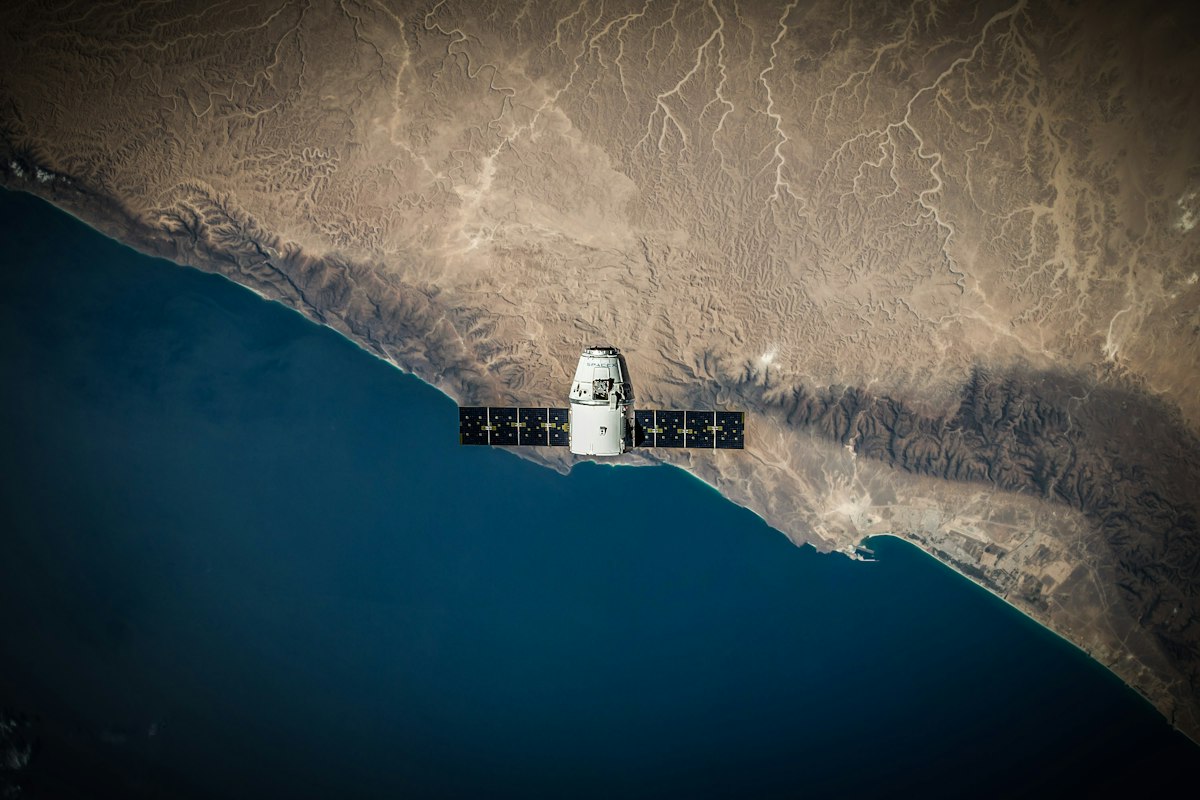
Orbital data centers just stopped being science fiction. For three years the artificial intelligence boom has been a story about physical limits, as land, electricity, water, and silicon all became chokepoints and the largest technology companies spent hundreds of billions of dollars racing to secure them. On August 4, SpaceX and Nvidia proposed a radical answer to that scarcity, confirming they are jointly designing the compute payload for Starmind AI1, a satellite engineered to run serious AI workloads in low Earth orbit. It is the clearest signal yet that orbital data centers have moved from concept toward a real engineering roadmap.
The AI Buildout Reaches Escape Velocity
The premise is audacious. Instead of hunting for another patch of desert with cheap power and a friendly utility, SpaceX wants to put the computers themselves in space, where sunlight is constant and the grid is irrelevant. Nvidia, the company whose chips underpin almost every major AI cluster on the ground, will supply the processors. Together they are betting that at least some of the world's compute belongs off the planet entirely, and that orbital data centers can eventually rival the giant facilities being stamped across Texas, Arizona, and Virginia.
Markets noticed immediately. Space-linked equities jumped, and the announcement reshuffled how investors think about the AI chip trade. What had been a purely terrestrial infrastructure story now has an orbital dimension, and orbital data centers have suddenly become a line item that analysts covering the two most closely watched names in the sector cannot ignore.
What SpaceX and Nvidia Actually Announced
The specifics matter, because they separate this from the usual space-startup vaporware. SpaceX said each Starmind satellite will carry Nvidia Rubin GPUs and Vera CPUs, the same class of hardware Nvidia positions for its most demanding data center workloads. Rubin is the architecture that follows Blackwell, and pairing it with Vera gives SpaceX a tightly integrated processor package built for large models rather than the reliability-first chips that have historically flown in space.
The scale of the design is startling. According to specifications SpaceX published for Starmind AI1, the spacecraft would stand roughly 30 meters tall when deployed, with a wingspan near 75 meters. Its computing payload could peak at 250 kilowatts and average about 175 kilowatts, with vehicle efficiency listed at 75 kilowatts per ton. Those are not the numbers of a communications relay. They describe a flying computing facility, and they explain why the company frames Starmind as the foundation of a network rather than a single experiment.
That framing connects to Nvidia's own strategy. In March the chipmaker unveiled a space computing platform built around its Space-1 Vera Rubin Module, claiming up to 25 times more AI compute for space-based inference than an H100. Nvidia had already lined up partners including Starcloud, Kepler Communications, and Planet to bring accelerated computing into orbit. The SpaceX partnership, detailed on the company's own Starmind page, gives that platform its most powerful backer and its most aggressive deployment plan. When two firms this central to the AI economy align on orbital data centers, the idea stops being a curiosity and starts looking like a category.
Why Orbit, and Why Now
The logic begins with energy. AI infrastructure has quietly become an electricity problem as much as a semiconductor one. Hyperscalers are signing nuclear deals, building dedicated generation, and waiting years for grid connections that never seem to arrive fast enough. In orbit, none of that applies. A satellite in sun-synchronous orbit bathes in near-constant solar energy, free of nightfall, weather, and the permitting battles that slow every terrestrial megaproject. Power that costs a fortune to secure on Earth is simply available above it.
Cooling and land follow the same pattern. Terrestrial clusters fight over water rights and thermal management. Space offers a vacuum and a cold sink, and it charges nothing for real estate. Orbital data centers could also process information where it is generated. Earth-observation satellites already flood ground stations with imagery that must be downloaded before anyone can use it. Running Nvidia accelerators in orbit lets a spacecraft analyze that data on the spot and beam only the insights back through high-bandwidth laser links to SpaceX's Starlink constellation.
Timing explains the urgency. SpaceX controls a piece of the puzzle almost no rival can match: its own launch fleet. Falcon 9 has made putting hardware into orbit routine, and Starship promises to push launch economics further still. That vertical integration means SpaceX can build a satellite, fly it on its own rocket, connect it through Starlink, and operate the compute aboard it. Because AI chips age quickly, cheap and frequent launches also make it feasible to swap tired accelerators for new generations, turning the constellation into something closer to a refreshable cloud than a fixed installation.
The Hard Problems Nobody Has Solved
None of this guarantees success, and the skepticism is well earned. No company has yet demonstrated that orbital data centers can compete economically or operationally with the facilities they aim to displace, and the barriers to viable orbital data centers are physical rather than merely financial. A GPU that fails inside a terrestrial building gets swapped by a technician within hours. A GPU that fails 500 kilometers overhead cannot be touched at all. SpaceX will have to engineer hardware that survives radiation, brutal thermal cycling, and years of operation with no physical maintenance whatsoever.
Radiation is the sharpest threat. The advanced semiconductors that make Rubin powerful are also delicate, and cosmic particles can corrupt memory and degrade silicon in ways that rarely trouble a data center in Nevada. That is almost certainly why SpaceX is co-designing the payload with Nvidia rather than simply bolting commercial chips to a bus. Radiation tolerance, redundancy, and fault recovery have to be built into the system from the start, and proving they work at scale will take years of flight data.
Then there is the million-satellite question. SpaceX has floated ambitions involving as many as one million orbital compute nodes, a figure that dwarfs every constellation ever flown. Such scale revives serious concerns about orbital debris, collision cascades, light pollution, and the atmospheric effects of relentless launches and reentries. Regulators have struggled to keep pace with Starlink alone. A build-out of orbital data centers an order of magnitude larger would test the legal and environmental framework of space itself, and the political case may prove harder to close than the engineering one.
A New Layer of Infrastructure, or a Costly Detour
The financial choreography is worth watching. Nvidia and Elon Musk are already entangled: an Nvidia equity stake taken during a $20 billion xAI round converted into SpaceX shares, giving the chipmaker a direct interest in Musk's space empire. The Starmind deal deepens that relationship and fits Nvidia's pattern of planting its architecture wherever AI workloads might emerge, from enterprise clouds to sovereign projects and now to orbit. If space computing becomes real, Nvidia would rather own the standard early than watch a rival architecture claim the high ground.
For SpaceX, Starmind offers a new internal customer for its launch business and a way to extend Starlink from a communications network into a computing platform. The company does not need to prove that every workload belongs in space. It only needs to find the niches where orbital data centers make economic sense, and satellite imagery, defense sensing, and scientific instruments all generate data that is expensive to move and cheap to process in place. Those beachhead markets could sustain the concept long before it challenges a terrestrial hyperscaler.
Whether Starmind becomes a genuine layer of global infrastructure or an expensive detour depends on unglamorous engineering that begins after launch. SpaceX must show that its chips run reliably in orbit, that solar-powered compute pencils out, that laser links move enough data, and that the whole system can compete on cost. Those are enormous ifs. Yet the direction of travel is unmistakable, and readers who follow this shift closely can track it through Blumefield as the story develops. Cloud computing pulled servers out of offices and into vast centralized halls. SpaceX and Nvidia are now asking whether the next address for the world's compute is not another state or country, but space.