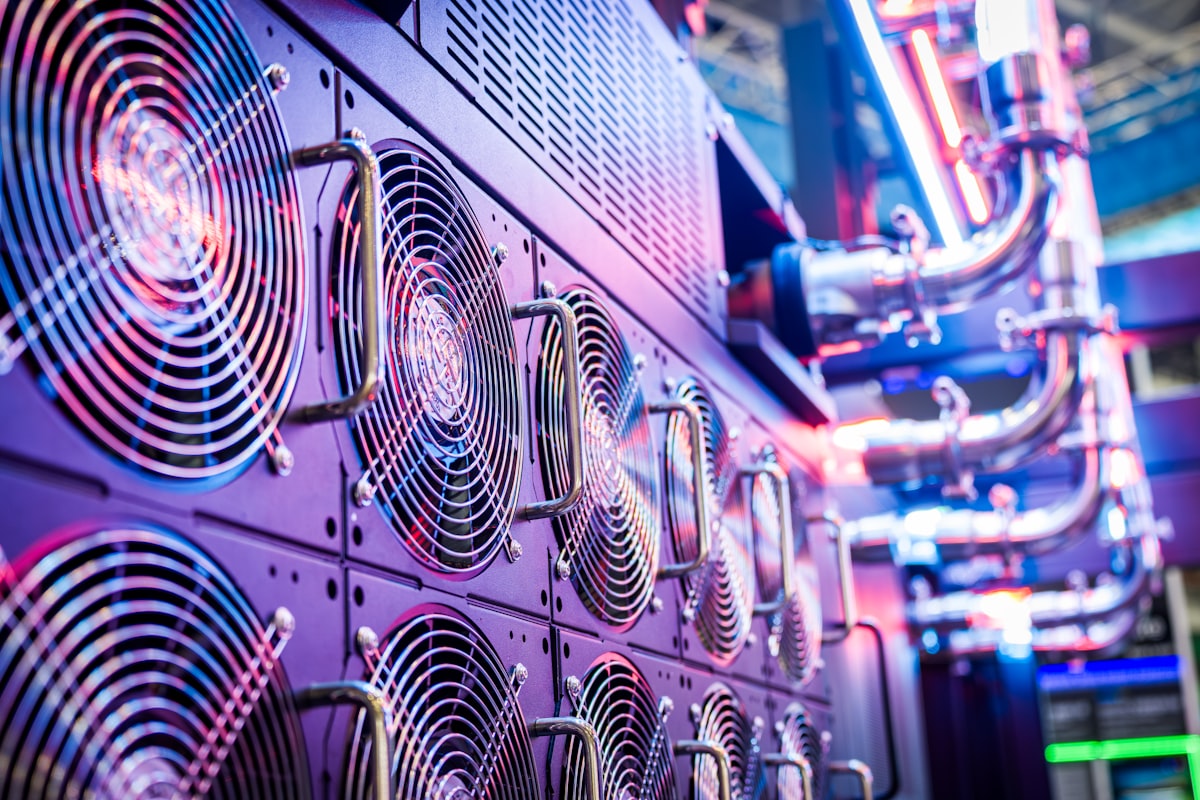
Samsung is in talks to buy Modine Manufacturing, a US heat-exchanger maker, in a deal reported at up to $8 billion. It would be the largest acquisition in the Korean giant's history. The target is not chips, but data center cooling, the bottleneck that now decides who can build AI.
By Blumefield | November 14, 2026
A Radiator Maker Becomes an AI Trophy
Samsung Electronics has entered talks to buy Modine Manufacturing, and the scramble that followed told you everything about how valuable data center cooling has become. Modine, a Racine, Wisconsin company that has built heat exchangers since 1916, watched its shares leap by roughly 28 percent on Friday after reports that the Korean conglomerate wanted to own it. A business once defined by truck radiators and factory ventilation is suddenly one of the most coveted assets in the artificial intelligence supply chain, because the hardest part of running an AI cluster is no longer buying the chips. It is stopping them from cooking themselves.
The numbers in circulation are large even by Samsung's standards. Modine carried a market value near $5.6 billion before the news broke, and Korean outlets reported that a full takeover could land between $7.5 billion and $8 billion once a control premium of 33 to 42 percent is folded in. At that level, the deal would rank as the biggest acquisition in Samsung's history, ahead of its 2016 purchase of Harman. Neither company has confirmed the discussions, and nothing has been filed, so the figure is still an estimate rather than a signed term sheet.
What is not in doubt is the strategic logic. Every operator racing to stand up AI capacity has hit the same wall, and data center cooling is the name of that wall.
Why Heat Became the Bottleneck
For most of the cloud era, data center cooling was a solved problem. Cold air pushed through raised floors did the job, and the people who designed those systems rarely made the front page. The current generation of AI accelerators broke that model. A single rack of the latest training hardware can draw more than a hundred kilowatts, several times what a conventional server rack consumed a few years ago, and air simply cannot carry that much heat away fast enough.
That physics problem has forced the industry toward liquid. Direct-to-chip plates, rear-door heat exchangers, coolant distribution units and full immersion systems are moving from pilot projects to standard specification inside flagship facilities. The shift is expensive, it is hard to retrofit, and the companies that can build and install it at scale are scarce. Analysts now treat thermal design as a gating factor on how quickly a hyperscaler can bring new compute online, which means data center cooling has quietly become a scheduling constraint on the entire AI boom, not a line item buried in the facilities budget.
This is the context that turned a quiet industrial supplier into a target. When power and heat decide how many chips you can actually switch on, the firm that manages the heat is no longer a vendor. It is part of the critical path.
Modine's Accidental Jackpot
Modine did not plan to become a data center cooling champion, but its recent results read like one. In the quarter that ended September 30, the company reported net sales of $994.4 million, up 35 percent from a year earlier. Inside that total, its data centers segment did the heavy lifting, with sales of $439.7 million, a 95 percent jump that was almost entirely organic. Over the first half of its fiscal year the segment booked $788.3 million, nearly double the prior period, and management pointed to record orders and backlog driven by hyperscale customers in North America. You can read the detail in the company's own investor filings.
The firm has also been reshaping itself around that momentum. On October 1 it completed the spin-off of its Performance Technologies business to Gentherm through a Reverse Morris Trust, shedding the legacy automotive-adjacent operations and leaving a cleaner company weighted toward data centers and commercial climate control. Management lifted its full-year outlook to between $3.1 billion and $3.2 billion in sales, and its data centers unit, which sells data center cooling systems under the Airedale name, now sits at the center of the story rather than the edge of it.
Not everything is frictionless. Data center gross margin slipped to 19.7 percent, down 470 basis points from a year earlier, as higher material, component and tariff costs ate into the windfall. The company is pouring cash into new capacity, which pushed free cash flow negative in the first half and lifted net debt past $570 million. Growth this fast is not free, and a buyer will be paying for a business still in the middle of a heavy investment cycle. Modine holds an investor day on November 18 that was meant to showcase its runway. It may instead become a referendum on whether that runway belongs to Samsung.
Samsung's Long March Into Cooling
For Samsung, the move is less a surprise than the next step in a deliberate campaign. The company has spent two years trying to build a serious heating, ventilation and air conditioning business to sit alongside its chips and consumer electronics. Last year it bought Germany's FläktGroup for roughly 1.5 billion euros to gain industrial climate technology. In 2024 it chased Johnson Controls' air conditioning arm and lost out to Bosch. This year it earmarked 240 billion won to build a dedicated production line for data center cooling equipment at its Gwangju plant. Modine would be the capstone, and it would plant Samsung directly inside the American market, the largest concentration of AI facilities on the planet. Samsung has laid out this HVAC ambition in its own corporate materials.
There is a deeper fit that makes the pursuit more than diversification. Samsung already builds the high bandwidth memory that sits next to the GPUs generating all this heat, and it runs some of the most thermally demanding semiconductor fabs in the world. Owning the cooling layer would let it sell into the data center as a system supplier rather than a component vendor, and it would hedge a memory business that lives and dies on brutal price cycles. If the AI buildout is the defining capital event of the decade, Samsung is trying to own more than one floor of the building.
The timing also tells you something about how the market now prices these assets. Samsung is reportedly willing to pay a premium of up to 42 percent for a company whose core products are, at bottom, sophisticated ways of moving heat from one place to another. A few years ago that valuation would have looked absurd. Today it reads as a rational bet that data center cooling demand has years left to run.
The Risks Under the Radiator
The obvious caution is that these are talks, not a transaction. Deals of this size collapse over price, over due diligence, and over the simple fact that one side gets cold feet. Samsung has walked away before, as the Johnson Controls episode showed, and a 100 percent takeover of a listed American manufacturer is a far heavier lift than a carve-out. Expect a review on national security and foreign ownership grounds, since a Korean giant acquiring critical infrastructure hardware that feeds US data centers is exactly the kind of transaction Washington now scrutinizes closely.
Then there is the cycle itself. Modine's valuation, and Samsung's willingness to chase it, both rest on an assumption that hyperscale spending keeps climbing. That spending has lately become the subject of nervous debate, with investors questioning returns on hundreds of billions of dollars of AI capital expenditure. If the buildout slows, a company that just doubled its data center cooling revenue would feel the reversal sharply, and a buyer who paid eight billion dollars near the top would feel it too. For now the momentum points the other way, and for a wider view of that capital surge, follow Blumefield and our ongoing coverage of the AI data center buildout.
Still, the signal is hard to miss. A century-old radiator company became a multibillion-dollar prize because it happens to make the one thing the AI era cannot do without. The chips get the headlines. The heat decides what gets built. Samsung, which understands silicon better than almost anyone, has placed its bet on the plumbing.