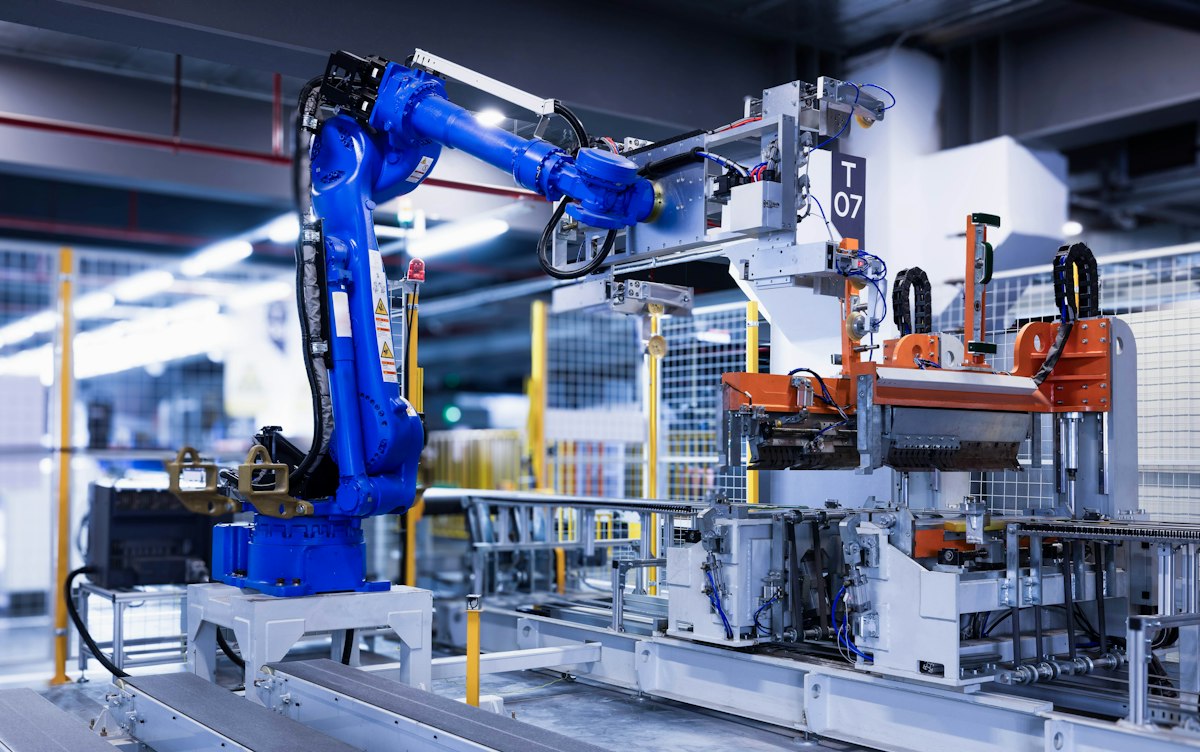
onsemi just agreed to buy Synaptics in an all-stock deal worth roughly $7 billion, and it is the clearest signal yet that the next AI gold rush will not happen inside data centers. The wager is on Physical AI, the machines that sense, decide and act in the real world. If the bet pays off, a sleepy power-chip maker becomes the company that wires intelligence into cars, factories and robots.
By Blumefield | June 28, 2026
A Quiet Deal With Loud Ambitions
On June 25, onsemi and Synaptics announced a definitive agreement that hands onsemi one of the more interesting franchises in edge computing and bets the combined company's future on Physical AI. The structure is all-stock, with Synaptics holders receiving 1.350 onsemi shares for each share they own, a fixed exchange ratio that values the target at about a 19 percent premium to where both stocks had been trading over the prior ten sessions. Total enterprise value lands near $7 billion.
That number is modest by the standards of a year that has already seen trillion-dollar valuations tossed around like loose change. What makes the deal worth attention is not the price but the thesis. onsemi has spent years as a specialist in power semiconductors and image sensors, the unglamorous silicon that runs electric vehicles and industrial equipment. Buying Synaptics is an attempt to leap from supplying components to selling complete intelligent systems, and management is explicit that Physical AI is the destination.
The timing is deliberate. Chief executive Hassane El-Khoury framed the announcement around a single observation, that artificial intelligence is migrating out of the cloud and into cars, machines and the built environment. The companies expect the transaction to close in mid-2027, pending approval from Synaptics shareholders and regulators. You can read the full terms in the onsemi announcement.
What Synaptics Actually Brings
For most consumers, Synaptics is an invisible company whose chips sit under laptop trackpads and fingerprint readers. That reputation undersells what it has become. Its Astra platform pairs purpose-built AI processors and neural processing units with a wireless connectivity stack spanning Wi-Fi, Bluetooth and GPS, all wrapped in an open-source software layer designed to get products to market quickly. In the language of the deal, this is a proven, scalable edge compute platform that onsemi could not have built fast enough on its own.
The strategic logic is about completeness. onsemi already owns the parts that move and measure energy, the power devices and sensors that let a machine perceive its surroundings and drive a motor. What it lacked was the brain in the middle, the connected compute that turns a sensor reading into a decision and an action. Synaptics supplies exactly that piece, which is why the company describes the combination as covering every layer of the edge AI stack rather than just one slice of it.
There is also a financial sweetener that the Synaptics board clearly weighed. The all-stock format lets its shareholders keep skin in the game, owning roughly 12 percent of the combined company on a fully diluted basis and sharing in whatever upside the Physical AI story generates. One Synaptics director is expected to join the onsemi board, a small governance detail that signals this is meant to be a genuine merger of capabilities rather than a quiet absorption.
The Four Pillars Pitch
onsemi's leadership has built its entire case around a tidy framework it calls the four pillars of Physical AI, which it lists as Power, Sense, Connected Compute and Control. The argument is that a machine operating in the real world needs all four working together, the ability to draw and manage energy, to perceive its environment, to compute a response and to act on it. Before this deal, onsemi was strong in three of those areas and conspicuously thin in connected compute. Synaptics fills the gap.
This is more than a marketing diagram. The practical payoff, according to onsemi, is higher dollar content on every platform it sells into. Instead of supplying a handful of power chips to an automaker or an industrial customer, the combined company hopes to deliver an integrated system with embedded intellectual property and software, the kind of product that commands fatter margins and stickier customer relationships. Management is guiding toward roughly $200 million in annual synergies and expects the deal to add to non-GAAP earnings within 18 months of closing.
The named markets are the ones that have captured the most imagination this decade, autonomous driving, robotics and augmented and virtual reality headsets. These are precisely the domains where Physical AI stops being a slide-deck phrase and becomes a hardware requirement, where latency, power efficiency and real-time control decide whether a product ships or stalls. Readers tracking how this race is unfolding can follow Blumefield for continuing coverage of the edge silicon land grab.
A $30 Billion Wager on Timing
The headline figure onsemi most wants investors to remember is not the purchase price. It is the claim that Synaptics expands its total addressable market by $30 billion, lifting the opportunity it can chase to $243 billion by 2030. That projection rests on a belief that the center of gravity in artificial intelligence is shifting from training enormous models in remote data centers toward running compact, efficient intelligence directly on devices at the edge.
There is a coherent macro story underneath the optimism. The cost and energy intensity of cloud inference keep climbing, and a growing share of useful AI work, from a car reading a road to a factory arm adjusting its grip, simply cannot tolerate a round trip to a distant server. Physical AI is the term the industry has settled on for this category, and onsemi is trying to plant its flag early rather than chase the trend after it matures. The supporting detail behind the market math is laid out in the company's regulatory filings with the Securities and Exchange Commission.
If the forecast holds, this is a cheap entry ticket into one of the largest expansions in the semiconductor industry's history. If it does not, onsemi will have diluted its shareholders to chase a market that arrived more slowly than the slides promised. That tension, between conviction and hope, is the real story of this deal.
The Risks Hiding in an All-Stock Deal
Every part of this transaction that looks clever on paper carries a matching risk. The all-stock structure protects onsemi's cash and balance sheet, but it ties the value Synaptics holders ultimately receive to onsemi's share price between now and a mid-2027 close. A long regulatory runway in a tense climate for cross-border chip approvals leaves plenty of room for the deal economics to drift before the ink dries, and the companies acknowledge as much in their cautionary disclosures.
Integration is the quieter danger. Synaptics is a software-rich, fast-moving consumer and edge business, while onsemi is rooted in capital-intensive power manufacturing with longer product cycles. Merging two cultures and roadmaps without losing the engineering talent that makes Synaptics valuable is the kind of challenge that has quietly sunk plenty of strategically sound acquisitions. The promised $200 million in synergies assumes that blend goes smoothly.
Then there is the bet itself. Physical AI is a compelling narrative, but it is still a narrative, and the $243 billion figure is a projection four years out, not a backlog. onsemi is wagering that intelligence at the edge becomes the next great semiconductor market and that owning all four pillars is the way to win it. It is a defensible bet and possibly a prescient one. It is also, for now, a bet, and the next two years of regulatory review and integration will decide whether the Physical AI thesis was foresight or expensive faith.