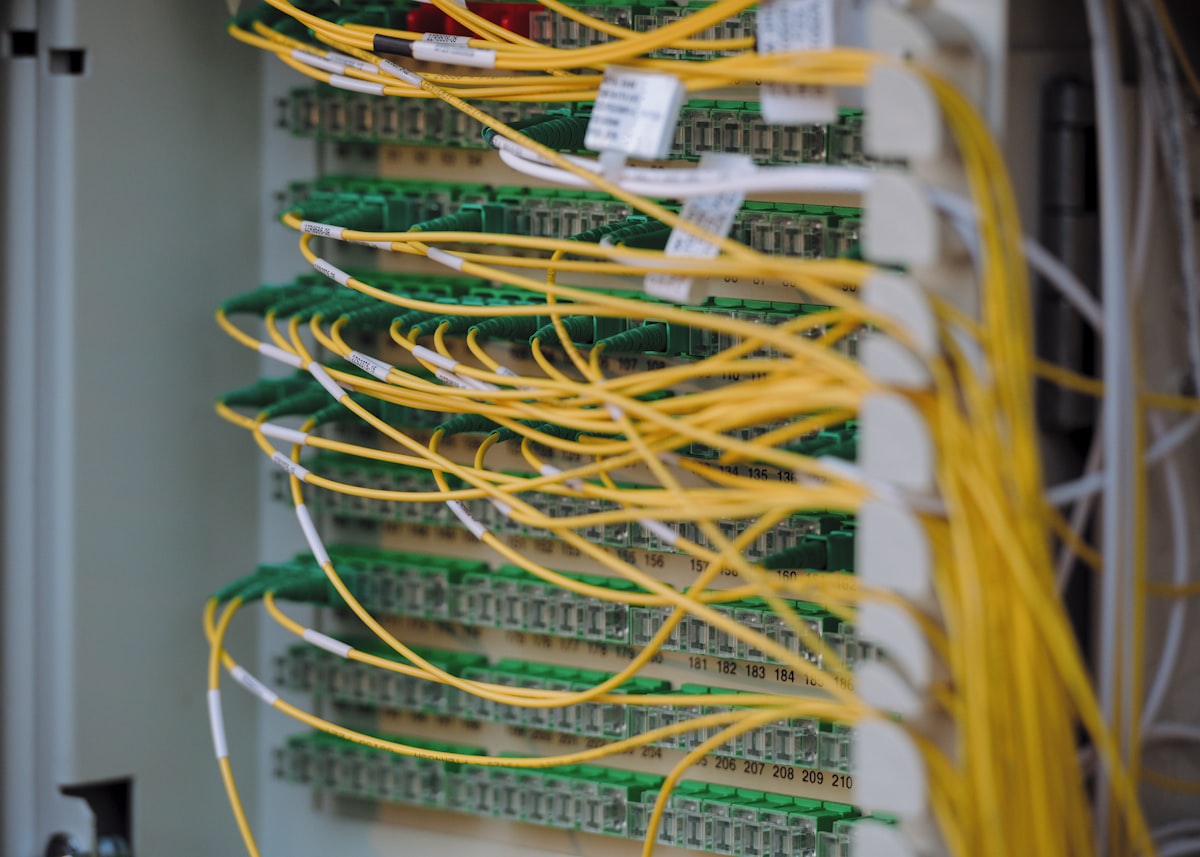
Optical Networking Becomes AI's Hardest Problem
Optical networking just became the most expensive real estate in the AI economy. Marvell Technology has agreed to acquire Lumentum in an all-stock transaction valued at roughly $115 billion, a deal that reframes optical networking as the center of gravity in the artificial intelligence infrastructure race. Announced on November 2, the agreement is the largest acquisition the chip designer has ever attempted, and one of the biggest technology mergers of the year. It is also a statement about where the constraints in AI have moved. For three years the story was compute, measured in GPUs and gigawatts. The new story is the humble photon, and the question of how quickly data can travel between tens of thousands of accelerators without drowning in heat and latency.
Lumentum makes the lasers, pump modules, and optical components that convert electrical signals into light and back again. Those parts sit inside the pluggable transceivers and switching gear that stitch together an AI cluster. As models scale across more chips, the wiring between them matters as much as the chips themselves. Marvell is paying a steep price to own that layer outright, and in doing so it is declaring that optical networking will decide who wins the buildout.
The Terms Behind the Biggest Optics Deal Ever
Under the agreement, each Lumentum share converts into 4.5 Marvell shares, valuing Lumentum at about $1,132 per share and carrying a premium of roughly 23.9 percent to the companies' closing prices on October 28, before deal speculation surfaced. When the transaction closes, Marvell shareholders will own around 67 percent of the combined company and Lumentum holders about 33 percent on a fully diluted basis. Both boards approved the deal unanimously, according to the companies' regulatory filing.
Matt Murphy will remain chairman and chief executive of Marvell, and three Lumentum directors, including chief executive Michael Hurlston, will join the enlarged board. Management expects more than $1 billion in annual run-rate cost savings, though it has not set a timetable for reaching that figure, and it says the deal should lift Marvell's non-GAAP earnings per share in the first full year after completion. Closing is targeted for the first half of 2028, pending shareholder votes and regulatory clearance across multiple jurisdictions. That is a long runway, and in a market moving this fast, eighteen months is an eternity.
The timing was not accidental. Lumentum reported fiscal first-quarter revenue of $1.26 billion, more than double the $533.8 million it posted a year earlier, with adjusted gross margin climbing to 53.2 percent from 39.4 percent. Its systems business, which barely registered a year ago, generated $508.4 million. Guidance for the current quarter points to as much as $1.625 billion in revenue. Marvell is not buying a turnaround. It is buying a business already riding the same wave it wants to dominate.
Why AI Data Centers Are Starving for Bandwidth
The logic starts with a physical problem. Training a frontier model means splitting the work across thousands of accelerators that must constantly exchange parameters and gradients. Every time that traffic crosses a copper connection, it loses signal integrity over distance and burns power as heat. Light does not degrade the same way, which is why optical networking has already taken over the longer hops inside and between data centers.
The pressure is now moving closer to the chip. Copper still handles the shortest connections, but as clusters grow and switch speeds climb toward 1.6 terabits per second and beyond, the industry is pushing optics down to the circuit board and eventually onto the package itself. Co-packaged optics, where the light engine sits beside the processor rather than in a separate pluggable module, promises lower power per bit at exactly the moment power is the scarcest resource in the business. Owning both the switching silicon and the optical networking hardware lets Marvell design these systems as one piece rather than negotiating across a fragmented supply chain.
This is the thesis Marvell is paying $115 billion to express. Optical networking is no longer a peripheral cost. It is becoming a determinant of how large a cluster can grow and how efficiently it can run. The companies framed the combination around exactly this shift, arguing that AI infrastructure is creating demand for connectivity capacity that the old division of labor between chipmakers and optics suppliers cannot satisfy.
Wall Street's Cold Reception
Investors were not impressed, at least not on day one. Marvell shares fell sharply after the announcement, extending a slide that began in late October when reports of advanced talks first leaked and the stock dropped more than 13 percent in a single session. Lumentum shares also retreated once trading resumed. The market's discomfort is easy to read. All-stock deals of this size dilute existing owners, the promised synergies are years away and vague on timing, and a close date in 2028 leaves ample room for integration risk, customer defection, and a cooling of the AI capital cycle that has lifted both companies.
There is also an uncomfortable pattern hanging over the whole sector, one that Blumefield has tracked through weeks of volatile trading. This acquisition lands in the same stretch that saw the Nasdaq shed a trillion dollars in a single Friday on fears that AI capital spending has outrun its returns. A $115 billion bet financed entirely in a currency, Marvell's own shares, that the market is actively repricing is a tell. It says management would rather spend equity than cash, and it invites the question of whether the buyer quietly thinks its stock is rich. None of that changes the long-term logic of the deal, but it does push the premium, the dilution, and the timeline onto Marvell's existing shareholders.
A Supply-Chain Power Play Against Broadcom
Strip away the market's near-term jitters and the strategic rationale is coherent. The deal is, at its core, a move against Broadcom, which has used its blend of custom silicon and networking assets to become the default arms dealer of the AI era. By folding Lumentum's optics into its own portfolio of data-center interconnect and custom compute chips, Marvell is assembling a rival full-stack offering, one that can sell hyperscalers a more complete optical networking system instead of a loose collection of components.
Vertical integration also hardens Marvell against supply risk. Optical networking components have been a chronic bottleneck, with lead times for lasers and related parts stretching for months. Controlling that capacity internally is worth a premium when your largest customers are racing to light up gigawatts of new capacity and will punish any supplier that cannot keep pace. The same instinct is driving consolidation across the industry, as every layer of the AI stack, from memory to power to networking, gets absorbed into fewer and larger hands.
Whether $115 billion proves the right price will not be clear until the cluster economics of 2028 come into focus. What is already clear is the direction of travel. The AI buildout is grinding through its component layers one at a time, and optical networking has arrived at the front of the line. Marvell has decided it would rather own that future than rent it piece by piece. The next test comes from regulators and from Marvell's own shareholders, who will vote on a deal that asks them to trade near-term dilution for a wager on the physics of light. In an industry that has spent three years proving compute is king, Marvell is betting that the connections between the chips are about to matter just as much.