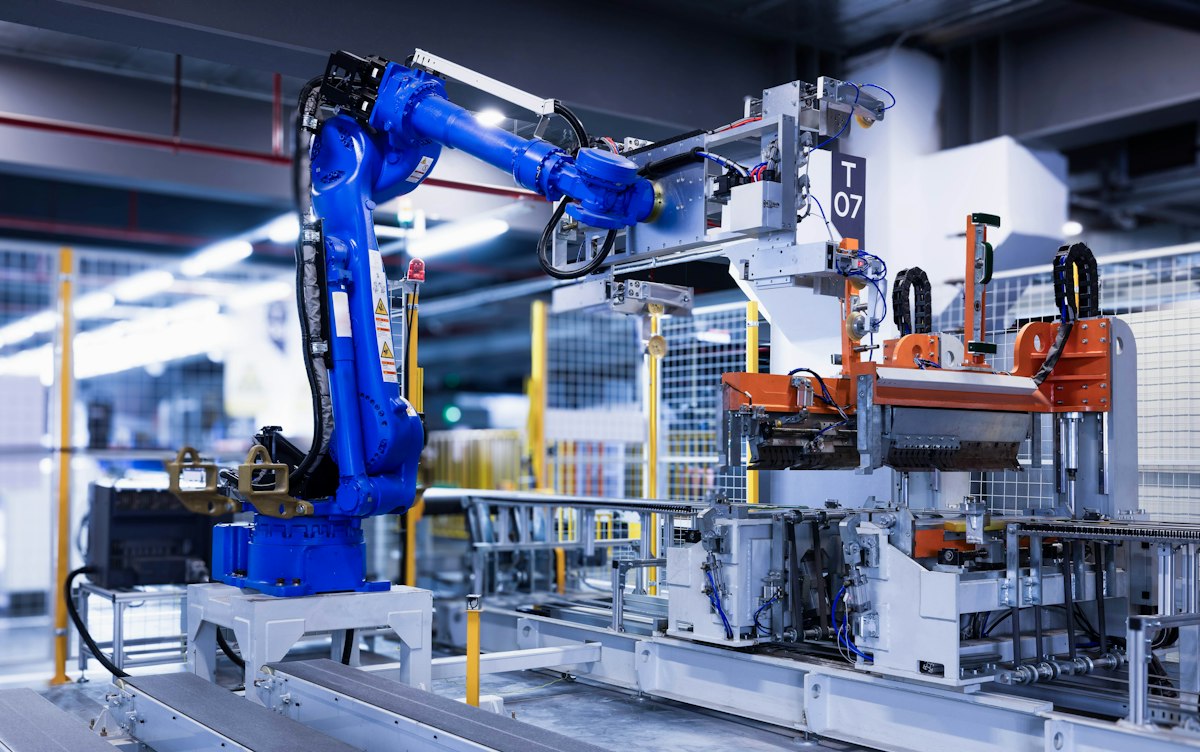
GXO, the world's largest contract logistics firm, has signed on for as many as 1,000 Apollo humanoid warehouse robots over the next four years. It is the boldest bet yet that machines shaped like people can earn their keep on a live warehouse floor. The deal could decide whether the industry's billion-dollar promise finally meets payroll.
By Blumefield | November 14, 2026
The Order That Changes the Conversation
For three years, the pitch for humanoid warehouse robots has run well ahead of the proof. Investors poured billions into machines built in the human form, promising they would stack totes, pick orders and plug the chronic labor gaps in the world's distribution centers. What was missing was a customer willing to put a real number on a real floor. On November 12, that number arrived. GXO Logistics said it had signed a letter of intent to deploy up to 1,000 Apollo robots, built by Apptronik, across its warehouse network over the next four years.
The scale is what makes the announcement land. GXO is not a startup staging a demo for a press release. It calls itself the world's largest pure-play contract logistics provider, with more than 150,000 workers, over 1,000 facilities and upward of 200 million square feet of operations. When a company that size commits to a four-digit fleet of humanoid warehouse robots, the rest of the industry stops and takes notes.
The agreement is a letter of intent rather than a binding contract, and GXO was careful to say so. Expanded joint trials begin in 2027, with the first commercial deployments in North America by late that year. Every robot has to earn its place against agreed targets for productivity, safety and uptime before the next one is switched on. Still, the direction is unmistakable. The question is no longer whether humanoids can walk. It is whether they can work.
Inside the Apollo Deal
Apollo is the product of more than a decade of robotics work. Apptronik, an Austin company that spun out of the Human Centered Robotics Lab at the University of Texas at Austin, describes itself as a human-centered physical AI company and has built 15 earlier machines, including NASA's Valkyrie, on the road to Apollo. The current model stands roughly five feet eight inches tall, weighs about 160 pounds, carries a 55-pound payload and runs on a swappable battery. Apptronik raised around $935 million this year across a Series A and an extension, and now employs close to 500 people.
GXO and Apptronik have worked together since 2024, and the new deal turns what had been a string of pilots into a scaling plan. The two companies ran joint evaluations at Apptronik's roughly 90,000-square-foot training facility, sometimes called a humanoid data factory, where Apollo was tested on more than 50 distinct logistics tasks. Inside GXO's buildings, the robots are being lined up for goods-to-person and person-to-goods picking, case and tote movement, packing and sortation. These are the repetitive, physically punishing jobs that grind down human workers and are hardest to staff.
"Humanoid robots are the latest evolution of intelligent automation," GXO chief executive Patrick Kelleher said in the announcement. Apptronik co-founder and chief executive Jeff Cardenas framed the appeal from the robot maker's side, saying GXO has the network and the operating discipline to take the technology to real scale. The commercial structure matters as much as the hardware. The rollout is expected to follow a robotics-as-a-service model, meaning GXO does not buy a thousand robots outright. It pays for the work they do, shifting the capital risk onto Apptronik and tying cost directly to performance.
The Economics That Have to Work
The reason humanoid warehouse robots have stayed in pilot purgatory is simple arithmetic. A machine that costs a fortune and moves slower than a person is a science project, not a tool. GXO's own leadership has been candid that the business case is not yet closed. Kelleher told investors earlier in 2026 that the company had not achieved a return on its humanoid investment and was still a couple of years away from it. The gaps he has pointed to are hand dexterity and raw speed, the two things people still do far better than robots.
Industry executives have talked openly about the threshold the technology must cross. The rough benchmark discussed across logistics circles is an all-in operating cost near $15 to $20 an hour, the point at which a tireless machine that runs multiple shifts starts to beat the loaded cost of human labor plus turnover. Robot prices are expected to fall by roughly half over the next two years, and operating costs are drifting down as the software improves. The service model is designed to let a customer like GXO ride that curve without stranding capital on hardware that is obsolete in 18 months.
That is the quiet logic of the GXO approach. By structuring the deal around service and performance targets rather than ownership, the company gets to scale humanoid warehouse robots in step with their actual capability. If Apollo hits its marks, the fleet grows toward 1,000. If it stumbles, GXO is not left holding a warehouse full of expensive mannequins. The risk sits with the vendor, which is exactly where a cautious operator wants it.
A Crowded Race for the Warehouse Floor
GXO is not betting on a single horse. The company was Agility Robotics' first commercial humanoid customer back in 2024, deploying the Digit robot under an early service arrangement, and it has since expanded that program across sites in Georgia, North Carolina and Tennessee. It has also run trials with Reflex Robotics, a maker of wheeled humanoids. By keeping several vendors in play, GXO is running a live bake-off across the whole category of humanoid warehouse robots rather than marrying its future to one design.
The competitive stakes are large because the addressable market is vast. GXO already operates close to 20,000 conventional robots across its network and has said it has run more than 45 separate humanoid pilots. Warehousing is the ideal proving ground for physical AI: structured environments, repetitive tasks, clear metrics and a persistent shortage of people willing to do the work. Whoever wins the warehouse wins a reference customer that validates the technology for every other industry watching.
For Apptronik, the GXO order is a credibility milestone in a field crowded with slick videos and thin revenue. The company is positioning Apollo not as a general-purpose android but as a workhorse tuned for logistics, the same insight that turned earlier automation waves into real businesses. A thousand-unit commitment, even a conditional one, is the kind of anchor deal that pulls in capital, talent and the next wave of customers.
What It Means for Workers and the AI Buildout
The arrival of humanoid warehouse robots at this scale forces an uncomfortable conversation about labor. GXO frames the move as a response to chronic difficulty staffing physically demanding roles, and says the goal is to let employees focus on higher-value work while machines handle the grind. That is the optimistic reading, and in a tight labor market with high turnover it is not unreasonable. The harder truth is that a machine benchmarked against a $15-an-hour cost is explicitly measured against a human wage, and warehouse workers can read a benchmark as well as anyone.
There is a broader strategic signal here too. Much of the artificial intelligence boom has lived in data centers and on screens, in chatbots and coding assistants. The GXO deal is a reminder that the next frontier is physical, that the same advances training language models are now training machines to move boxes. If Apollo and its rivals close the dexterity and speed gaps, the economic impact spreads far beyond logistics into manufacturing, retail and elder care. For more on how physical AI is reshaping industry, see Blumefield.
None of this is guaranteed. A letter of intent is a statement of ambition, not a shipped product, and the history of warehouse automation is littered with promising pilots that never scaled. But the GXO commitment moves the debate onto new ground. The industry has spent years asking whether humanoid warehouse robots could actually work. Starting in 2027, on real floors and against real targets, it will finally find out. Follow Blumefield for continuing coverage of the physical AI race.