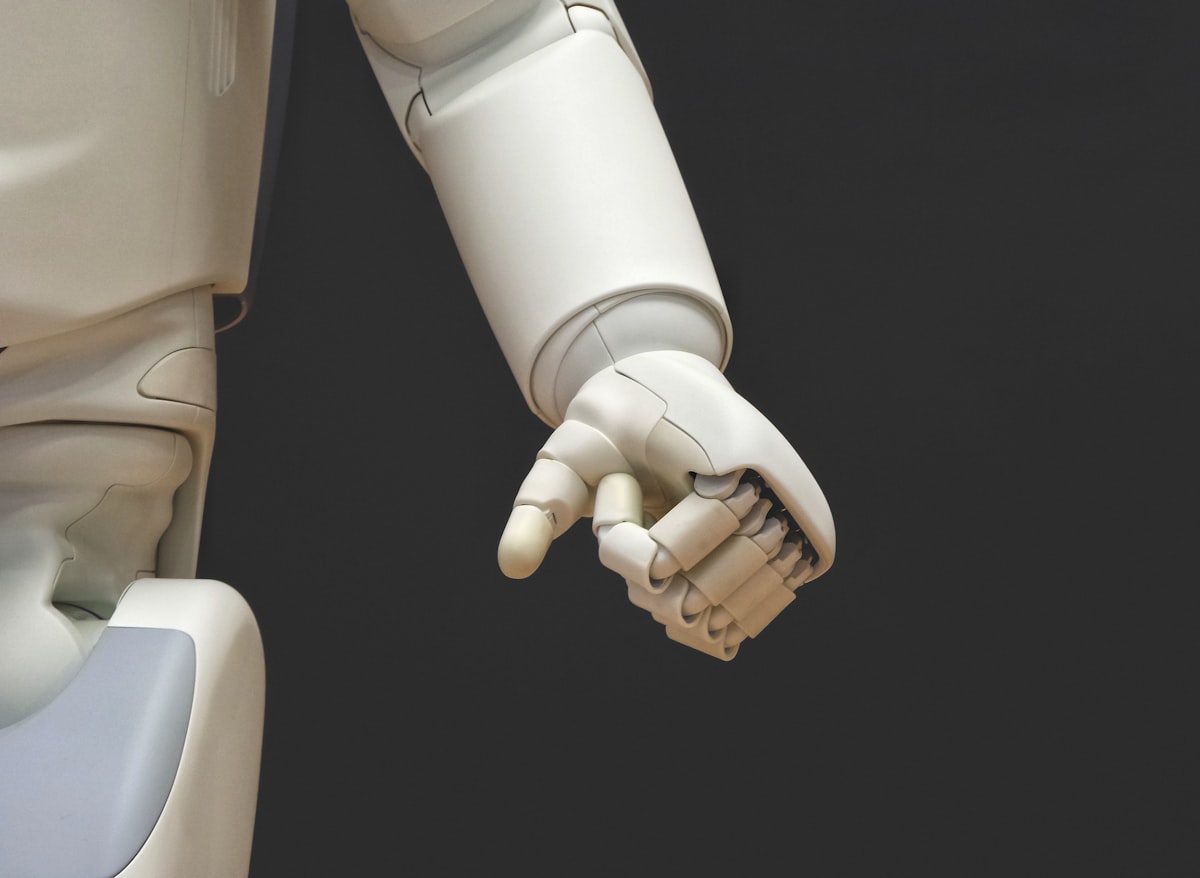
Humanoid robotics is finally getting the test it has spent a decade dodging, a verdict from public-market investors.
By Blumefield | July 29, 2026
A Robot Maker Reaches for the Bell
For a decade, humanoid robotics has been the technology that was always five years away. Now one company wants to put the promise to a public-market vote. Agility Robotics, the Salem, Oregon maker of the two-legged Digit robot, has agreed to merge with Churchill Capital Corp XI, the blank-check vehicle run by veteran financier Michael Klein, in a deal that values the business at a pre-money equity figure of $2.5 billion. When it closes, expected by the end of 2026, the combined company plans to trade on the Nasdaq under the ticker AGLT.
The mechanism is a special purpose acquisition company, a structure that fell out of fashion after the 2021 boom soured. Its revival here is telling. Agility is choosing speed and certainty over the scrutiny of a traditional listing, and it is doing so to grab a title none of its rivals can yet claim. If the merger completes, Agility becomes the first publicly traded American company dedicated solely to humanoid robotics, beating far better-capitalised competitors to the bell.
The transaction is designed to hand Agility more than $620 million in gross proceeds. Roughly $420 million comes from cash sitting in the Churchill trust, and about $200 million arrives through a private placement led by the Taiwanese manufacturing giant Foxconn, alongside existing and new institutional backers. That war chest matters, because building robots is expensive and Agility is nowhere near covering its own costs. The deal is less an exit than a refuelling stop, and the destination is a market its own management pegs at roughly $1 trillion across United States manufacturing, distribution and logistics.
What Digit Actually Does
Strip away the valuation and you find an actual machine doing actual work. Digit stands about five feet nine inches tall, walks on two legs, and is built to move through spaces designed for people rather than for conveyor belts. The current model lifts up to 35 pounds and handles the dull, repetitive tasks that wear human bodies down, shuttling totes and tending machines for as long as 20 hours a day. The forthcoming Digit v5 raises the ceiling considerably, with swappable hands, a 50-pound lifting capacity, a reach of more than seven feet, and the ability to run for up to 22 hours.
Crucially, Agility can point to deployments that already exist. The company says Digit is in commercial use with the auto-parts supplier Schaeffler, the logistics group GXO, Toyota Motor Manufacturing Canada and the Latin American e-commerce leader Mercado Libre. Across nine customer facilities, Digit has logged more than 65,000 hours of real-world operation. Those are not lab demonstrations or staged videos. They are hours on live floors, which is the single strongest argument the company has that humanoid robotics has crossed from spectacle into utility.
The next generation leans heavily on the theme of safety. Agility describes Digit v5 as the world's first AI-enabled cooperatively safe humanoid robot, meaning it is engineered to work beside people without cages or barriers. That claim rests on a proprietary physical AI platform that fuses perception, reasoning and motion, trained on data harvested from those commercial deployments. The company recently became the launch partner for Nvidia's Halos safety system for robotics, and it works with Google DeepMind on the underlying intelligence. To manufacture at scale it has built RoboFab, a facility designed to produce up to 10,000 robots a year, and roughly 75 percent of Digit's components are sourced inside the United States.
The Numbers Behind the Pitch
Here is where the story gets harder. The headline that Agility wants investors to remember is more than $300 million in committed, multi-year orders for Digit v5, supported by a pipeline of over 30 prospective customers. It is a genuinely large figure for a company selling a product that barely exists in its next-generation form. It is also, on closer reading, a good deal softer than it sounds.
The initial filings connected to the deal are candid about the caveats. That $300 million, the fine print concedes, "is not a measure of current period revenue." It depends on Agility hitting a series of contractual milestones, and it flows from a single three-year contract for 1,000 robots placed by a customer the company has not named. One unnamed buyer, one order, converted into a marketing centrepiece. The SEC filings released with the transaction do not disclose Agility's revenue at all, and they indicate the company remains firmly unprofitable. Operating expenses climbed to about $111 million in 2025 from $71 million the year before, and the business burned through roughly $100 million in cash over the period, according to figures it describes as preliminary and unaudited.
None of this is unusual for a hardware company chasing a frontier market, and the SPAC route conveniently allows Agility to publish forward-looking projections that a conventional IPO would treat more cautiously. But it does frame the wager clearly. Investors are being asked to fund a promising, loss-making manufacturer on the strength of pilot hours and a pipeline, not on a proven income statement. A fuller accounting, including revenue and profit, is expected later in the process through a Form S-4. Until then, the case for humanoid robotics as a public-market asset rests as much on faith as on financials, a tension worth watching closely on Blumefield as the S-4 lands.
Beating Better-Funded Rivals
What Agility lacks in capital it is trying to make up in timing. The company has raised more than $390 million in equity since its 2015 founding, a modest sum next to the giants circling the same opportunity. Silicon Valley's Figure AI carries a reported $39 billion valuation after raising over a billion dollars, and Hyundai-owned Boston Dynamics has spent years refining its Atlas humanoid. Elon Musk's Tesla is pouring resources into its Optimus robot, though inside an already public company rather than as a dedicated humanoid robotics play. By reaching the market first as a pure bet on the category, Agility gives investors something none of those rivals currently offer, a listed stock that rises and falls purely on the fate of walking robots.
The company's leadership reinforces the pitch. Chief executive Peggy Johnson arrived from senior roles at Microsoft and Magic Leap, lending the operation a commercial polish that engineering-led startups often lack. Co-founder and chief robot officer Jonathan Hurst supplies the technical credibility, having spent years arguing that cooperative safety, robots and humans sharing space without barriers, is the true unlock for scaled adoption. Their message is consistent. Humanoid robotics is not a science project any more, it is a labour-shortage solution arriving at exactly the moment employers are struggling to staff warehouses and factories.
There is also a quiet Amazon subplot. The e-commerce giant was an early Agility investor, backing a 2022 funding round, and it has run multiple pilots of Digit inside its warehouses. Agility is careful to keep the door open, saying it looks forward to working with Amazon again once the next-generation, cooperatively safe robot launches. A renewed Amazon relationship would transform the demand picture overnight, which is precisely why the company keeps mentioning it.
The Real Test Ahead
The Agility listing is a bet placed on behalf of an entire industry. If AGLT trades well, capital will flood toward every humanoid robotics venture with a prototype and a pitch deck, and the sector's long-delayed commercial era will finally have a public benchmark. If the stock stumbles, the reckoning will be swift, and the "always five years away" label will harden into something closer to a verdict. The company is effectively asking the market to price a technology before the technology has proven it can pay for itself.
The variables are stark. Agility must convert pilot hours into repeat orders, turn one anchor contract into many, and manufacture reliably at a scale it has never attempted, all while burning cash and answering to public shareholders every quarter. Its safety-first architecture and its Nvidia and Google DeepMind partnerships give it a credible technical foundation, but execution risk in hardware is unforgiving. A single high-profile deployment failure could set the narrative back years.
For now, the more measured reading is that Agility has bought itself time and a stage. The $620 million keeps the lights on and the production lines moving, and the Nasdaq ticker gives humanoid robotics its first real referendum. Whether that referendum ends in vindication or disappointment, it will tell the world something it has wanted to know for a decade, which is whether these machines can actually earn their keep. Blumefield will be tracking the outcome from the first day of trading, and readers can follow the full arc of the story on Blumefield, alongside the company's own investor disclosures at Agility Robotics.