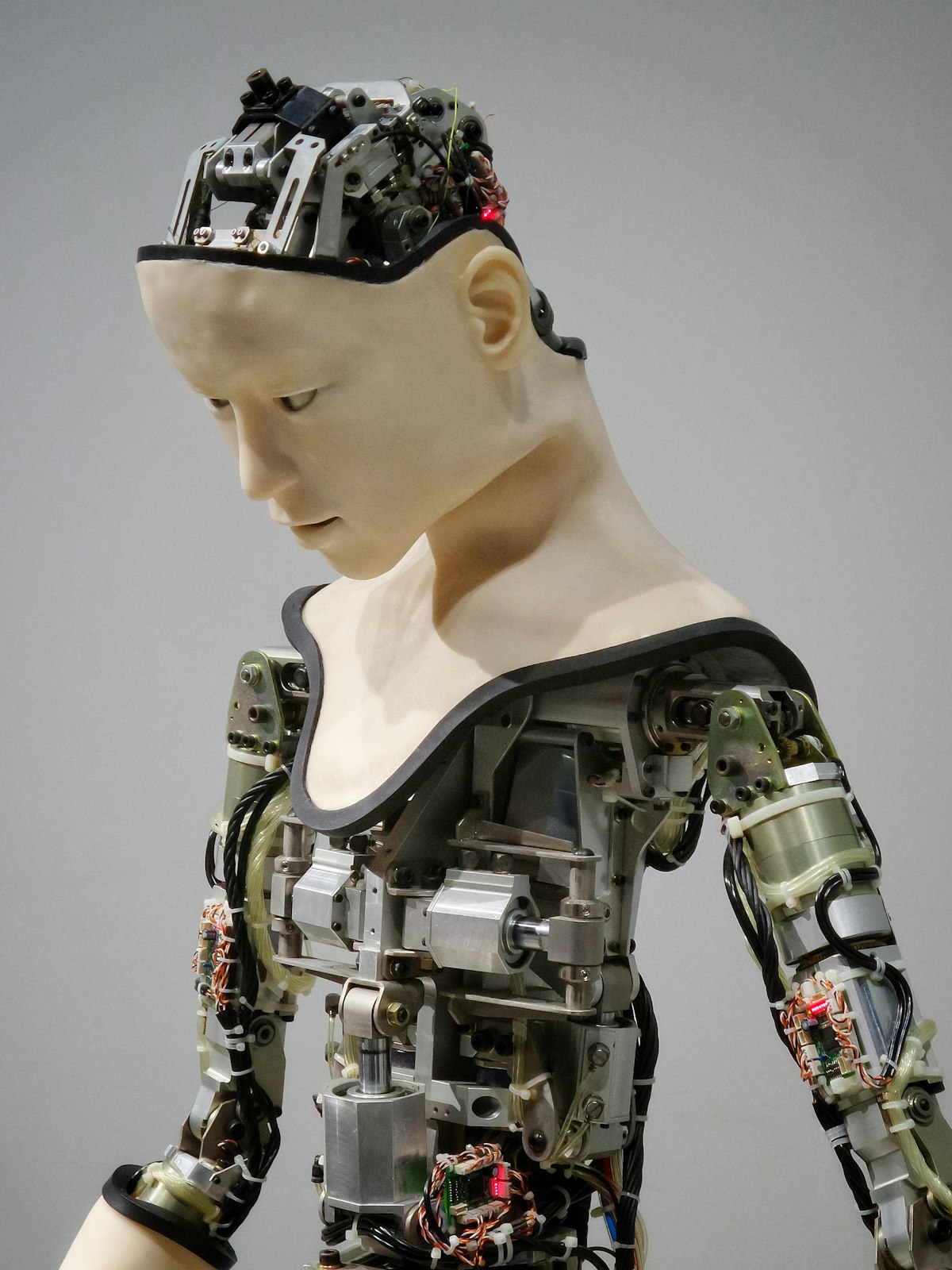
The humanoid robot IPO that Unitree priced in Shanghai this week is the moment the industry has waited years for, the point at which walking machines stop being a demo reel and become a tradable asset. At a valuation near $9 billion, this humanoid robot IPO also arrives loaded with a geopolitical charge few listings carry, landing just weeks after Washington branded the company a military threat.
By Blumefield | August 6, 2026
A $9 Billion Bet on Steel and Servos
Hangzhou-based Unitree Robotics priced its Shanghai listing at 150.8 yuan per share this week, valuing the company at around 61 billion yuan, or roughly $9.04 billion, and turning the year's most anticipated humanoid robot IPO into a concrete number. The company is selling 40.45 million new shares, about 10 percent of its enlarged capital, on the STAR Market, Shanghai's Nasdaq-style board for technology firms. Subscriptions open on August 10. At completion, Unitree becomes the first mainland-listed company built primarily around humanoid machines.
The scale of the offering is modest by hyperscaler standards, raising about 6.1 billion yuan or $904 million. Its symbolic weight is not. For years, humanoid robotics lived in the demonstration reel, a genre of viral videos in which machines danced, backflipped, and stumbled through obstacle courses without ever generating meaningful revenue. Unitree, known in Chinese as Yushu Technology, is asking public markets to treat the category as a business rather than a science project, and it is doing so with financials that most venture-backed peers cannot come close to matching.
Founder and chief executive Wang Xingxing has spent the run-up cultivating the kind of political visibility that matters in Beijing. His robots performed at the Spring Festival Gala, the most-watched broadcast on earth, and he has appeared alongside China's most prominent business leaders at a gathering hosted by President Xi Jinping. That proximity to the state is an asset at home. Abroad, as this humanoid robot IPO is about to demonstrate, it is fast becoming a liability. Unitree's own prospectus filings route through the Shanghai exchange rather than any Western venue, a choice that looks less like preference and more like necessity.
The Numbers That Don't Look Like a Startup
Investors weighing this humanoid robot IPO will start with the accounts, and Unitree's read like a profitable industrial firm rather than a cash-burning moonshot. Revenue reached 1.71 billion yuan in 2025, up 335 percent year over year, with humanoid robots alone contributing 867.8 million yuan. Adjusted net income climbed to around 600 million yuan, and operating cash flow tripled. The gross margin sat above 60 percent, richer than Apple's and closer to a luxury house than a hardware manufacturer. The engine behind those margins is vertical integration: Unitree designs its own motors, reducers, robotic hands, and lidar sensors rather than buying them off the shelf.
Volume is where the story turns from impressive to startling. Unitree shipped more than 5,500 humanoid units in 2025, a figure its prospectus places far ahead of Western rivals Figure AI and Agility Robotics, each credited with roughly 150 units in the same period. Tesla's Optimus remains in internal testing and has not been sold. On the company's own accounting, that is a lead of better than thirty to one over its closest named competitors, and its production-to-sales ratio near 96 percent suggests demand is absorbing nearly everything it builds.
Pricing tells the strategic story. The average selling price of a Unitree humanoid fell more than 70 percent in two years even as margins expanded, a combination that usually signals either accounting sleight of hand or a genuine manufacturing edge. The G1 base model now starts near 85,000 yuan, under $13,000, and the smaller R1 Air undercuts that further. The catch, familiar to anyone who has priced enterprise hardware, is that the cheapest units ship locked. Developers who want to actually build on the platform pay several times more for the EDU edition with a full software kit. The headline price wins attention; the real margin lives in the tiers above it.
Washington's Shadow Over the Offering
The timing of this humanoid robot IPO is impossible to separate from the sanctions closing in around it. In June, the US Department of Defense added Unitree to its Section 1260H list of Chinese military companies, a roster that swelled to 188 firms and now sits alongside Alibaba, BYD, and Baidu. Designation does not by itself ban commercial sales, but it poisons the well for US government contracts and signals to allied buyers that Washington views the hardware as a strategic concern. Days later, regulators moved further, with proposals to bar foreign-made humanoid robots outright and an FCC covered-list process that would deny the equipment authorizations Unitree needs to legally sell wireless devices into the American market.
Security researchers have handed the hawks their ammunition. Unitree's G1 has been the subject of published findings describing a wormable exploit and undisclosed data transmission back to servers in China, precisely the profile that turns a trade dispute into a national-security file. Whether those vulnerabilities reflect negligence or design, they have already reshaped the company's addressable market. The United States, and quite possibly a widening circle of its partners, is being walled off from one of the fastest-moving robotics firms on the planet before the shares even begin trading.
For public investors, that is the central tension baked into the valuation. A company growing revenue at triple digits with luxury-grade margins would normally command a global multiple. Unitree is being asked to justify its price on a market that may end at China's borders and those of countries unwilling to defy Washington. The US Defense Department's designation does not appear on the balance sheet, but it hangs over every projection in the prospectus.
DeepSeek, Distribution, and the China Stack
If Unitree is cut off from the West, it is deeply plugged into China's domestic AI ecosystem, and the IPO makes that explicit. Among the strategic investors backing the offering is DeepSeek, the model lab whose low-cost systems rattled Silicon Valley and Wall Street over the past year. A humanoid needs a brain as much as it needs actuators, and pairing China's most efficient robot builder with one of its most capable model makers is a statement of intent about a fully domestic stack, from silicon to servos to software.
That vertical alignment is the quiet thesis of the whole listing. Unitree's motion-control algorithms are tuned to deliver strong performance without the most expensive compute, a design philosophy that dovetails with a Chinese AI industry engineered around US chip restrictions. Where American robotics firms assume access to frontier accelerators, Unitree and its partners are building for a world where that access is uncertain, and treating constraint as a design specification rather than a handicap. You can read DeepSeek's model documentation as the other half of a machine Unitree is assembling in public.
The domestic market it is optimizing for is enormous and increasingly captive. Chinese provinces are competing to host automation, factories face rising labor costs, and the state has designated embodied AI a strategic priority. A humanoid robot IPO backed by a marquee model lab, blessed by Beijing, and aimed at a home market hungry for industrial automation does not need Western customers to grow for years. Whether it can become the global standard, rather than the national one, is the question the sanctions have already half-answered.
What a Successful Debut Would Unlock
A strong Unitree open would ripple far beyond one balance sheet. Robotics sits at the intersection of AI models, sensors, semiconductors, batteries, and industrial automation, and the sector has lacked a clean public benchmark. A successful humanoid robot IPO would hand dozens of private robotics companies, in China and elsewhere, a valuation anchor and a template, and it would pressure Western rivals still shipping in the low hundreds to justify why they trail so badly on volume. As Blumefield has tracked across the humanoid buildout, the gap between demonstration and deployment is where fortunes will be made or lost.
There are reasons for caution that no prospectus can dissolve. Margins this rich rarely survive a price war, and the humanoid field is heading straight into one. R&D as a share of revenue has fallen sharply as sales exploded, a ratio that flatters current profits but may not hold as competition forces heavier investment. And the sanctions overhang means the most valuable customers on earth are, for now, off limits, capping the upside that would otherwise justify a premium multiple.
Still, the significance of this moment is hard to overstate. A category that lived on YouTube is walking onto a public exchange with real revenue, real profit, and a state-backed ecosystem behind it. The verdict that matters arrives when subscriptions open on August 10, and the market finally prices what a humanoid robot IPO is worth in a world splitting into two technology spheres. For continuing coverage of that split, follow Blumefield.