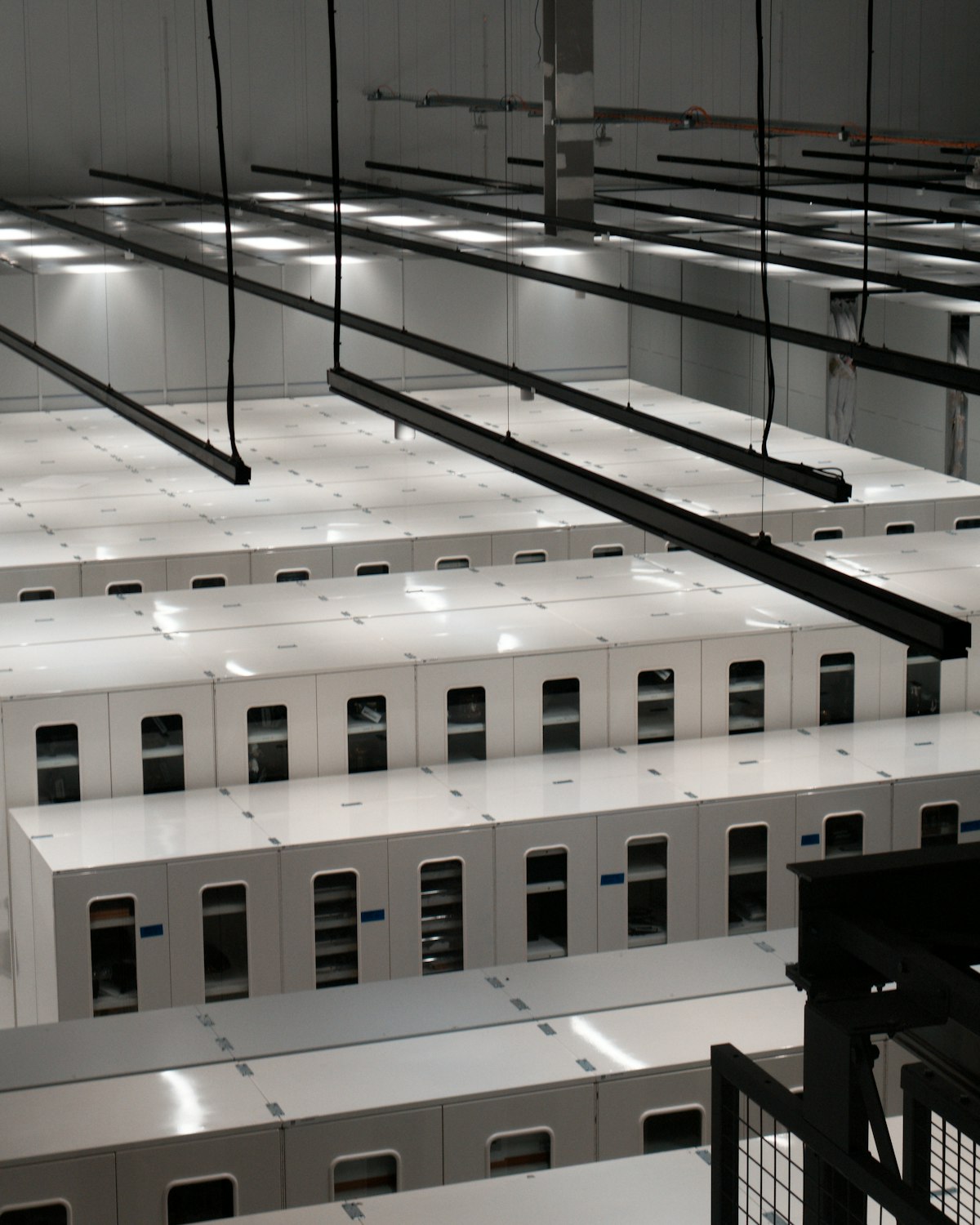
BlackRock's Larry Fink has a blunt warning for the towns trying to halt AI data centers: stop, and you may crash the economy. With trillions in investment and much of recent US growth riding on the buildout, a spreading moratorium could tip the country into recession. The backlash, and the bill now in Congress, suggest the fight is only beginning.
By Blumefield | October 19, 2026
The Warning From the Top of Wall Street
Larry Fink does not usually deal in recession talk. So when the chief executive of the world's largest asset manager said this week that halting the construction of AI data centers could tip the United States into a downturn, the comment landed with unusual weight. Speaking to CNBC on October 14 after BlackRock reported $2.6 billion in third-quarter net income, Fink argued that so much of recent American growth now rests on the buildout that stopping it would remove one of the economy's few load-bearing walls. "A moratorium of some sort in this country" would cause a recession, he said.
Fink went further, calling most of the opposition to AI data centers "misinformation" and insisting the facilities are generating "more new jobs than ever before." His message was aimed squarely at a growing movement of towns, counties and cities that want to slow or stop the server farms spreading across the national map. In his telling, the people trying to protect their communities from noise, water draws and higher power bills are unwittingly threatening the engine keeping the expansion alive. "Data centers are not the problem," he said.
The remark matters because of who made it. BlackRock oversees trillions of dollars and has become one of the largest private financiers of the physical infrastructure behind the AI boom. When its leader frames AI data centers as the difference between growth and contraction, he is not only describing the economy. He is describing the exposure of his own firm, its clients and the broader market to a single, concentrated bet.
Why the Math Backs Him Up
Strip away the politics and Fink's warning rests on a hard set of numbers. McKinsey projects that global investment in AI data centers will approach $7 trillion by 2030, with more than 40 percent of that spending landing in the United States. That is not a rounding error in a $30 trillion economy. It is a capital wave large enough to move national growth figures on its own, which is precisely why a sudden stop would be felt everywhere from construction payrolls to turbine orders to the price of a graphics chip.
The demand signals are just as stark. Industry trackers put global data center occupancy at 97 percent, with 77 percent of the current construction pipeline already pre-committed to tenants before the concrete is poured. In the United States, demand is running at roughly five times its level of two years ago, and vacancy has sat near 1 percent for three straight years. Those are not the metrics of a speculative bubble inflating on hope. They are the metrics of an industry that cannot build fast enough to keep up with the compute that AI models are consuming.
That scarcity is the core of Fink's argument. If these server farms were half-empty, a moratorium would simply pause an oversupplied market. Instead, every gigawatt that does not get built is capacity the AI economy has already spoken for. The risk he is pointing at is not that the buildout is reckless, but that it has become so central to growth that interrupting it would ripple outward faster than any other sector could absorb.
The Revolt in the Suburbs
The trouble for Fink is that the backlash he dismisses as misinformation is real, local and growing. San Francisco this month moved to pause new hyperscale projects, joining a lengthening list of jurisdictions putting the brakes on development. Loudoun County in Virginia, the densest concentration of server capacity on earth, voted to block new applications. The shortest moratoriums have lasted a week, while the longest now stretch up to a year and a half. What began as scattered zoning disputes is hardening into a pattern.
The concerns driving it are not imaginary. A Pew Research Center survey found that at least 49 percent of Americans believe data centers are mostly bad for the environment, for home energy costs and for the quality of life of people living nearby. Residents point to strained power grids, rising electricity bills, heavy water use for cooling and the industrial sprawl of windowless buildings across what were once fields and suburbs. Grid upgrades and energy supply remain, in the industry's own words, far from resolved.
This is where the story becomes a genuine collision rather than a simple morality play. Fink is right that the investment is enormous and that the jobs are real. His critics are right that the costs are being borne disproportionately by the communities hosting the hardware. Both things can be true at once, and the fight over AI data centers is really a fight over who pays for the AI economy and who profits from it. For the broader context on how local opposition is already reshaping the map, see our coverage of the San Francisco moratorium.
Washington Picks Sides
The dispute has already reached Congress, and the lines are drawn in familiar colors. The AI Data Center Moratorium Act, introduced over the summer by Representatives André Carson and Alexandria Ocasio-Cortez along with Senator Bernie Sanders, sits in early committee review. It would tie new development to worker and environmental protections and would ban the export of American AI computing infrastructure to countries without adequate safeguards. Its backers frame the buildout as a public cost that private firms have been allowed to externalize onto ordinary ratepayers.
On the other side stands the White House. President Trump has thrown his support behind the buildout in blunt terms, urging communities to "let data reign" and warning that towns which reject the facilities will end up "backwards and poor." His administration treats AI data centers as strategic infrastructure in the race against China, a framing that casts local resistance as a national security liability rather than a legitimate grievance.
Between those poles sits the awkward truth that neither side fully acknowledges. A federal push to accelerate construction cannot override the local grids, water tables and zoning boards that actually determine where a data center can go. And a patchwork of local moratoriums, if it spreads far enough, could produce exactly the countrywide slowdown Fink warns about without anyone in Washington ever voting for it. The policy is being written in county meetings, not just committee rooms.
The Trillion-Dollar Dependency
What makes Fink's warning more than a lobbying line is the concentration it exposes. An economy that leans this heavily on a single category of investment has traded diversification for momentum. As long as the AI data centers keep rising and the compute keeps selling, the growth looks robust. The moment the buildout stalls, whether from moratoriums, power shortages, equipment bottlenecks or a crack in AI demand itself, the same concentration that powered the expansion would accelerate the fall.
That is the uncomfortable symmetry beneath this week's headlines. The strength of the AI boom and its fragility are the same fact seen from two angles. Fink is telling the country that it can no longer slow down without consequences, which is another way of admitting how dependent it has become. Investors who have ridden the infrastructure trade should hear both halves of that message, not just the bullish one.
The near-term signals to watch are concrete. Count the jurisdictions adopting moratoriums, track whether the Sanders bill gains committee momentum, and watch electricity prices in the regions hosting the largest clusters. If local resistance keeps compounding while federal support stays rhetorical, the gap between the two could decide whether the AI data centers remain the economy's engine or become its single point of failure. For ongoing analysis of the AI infrastructure build, follow the series at Blumefield.