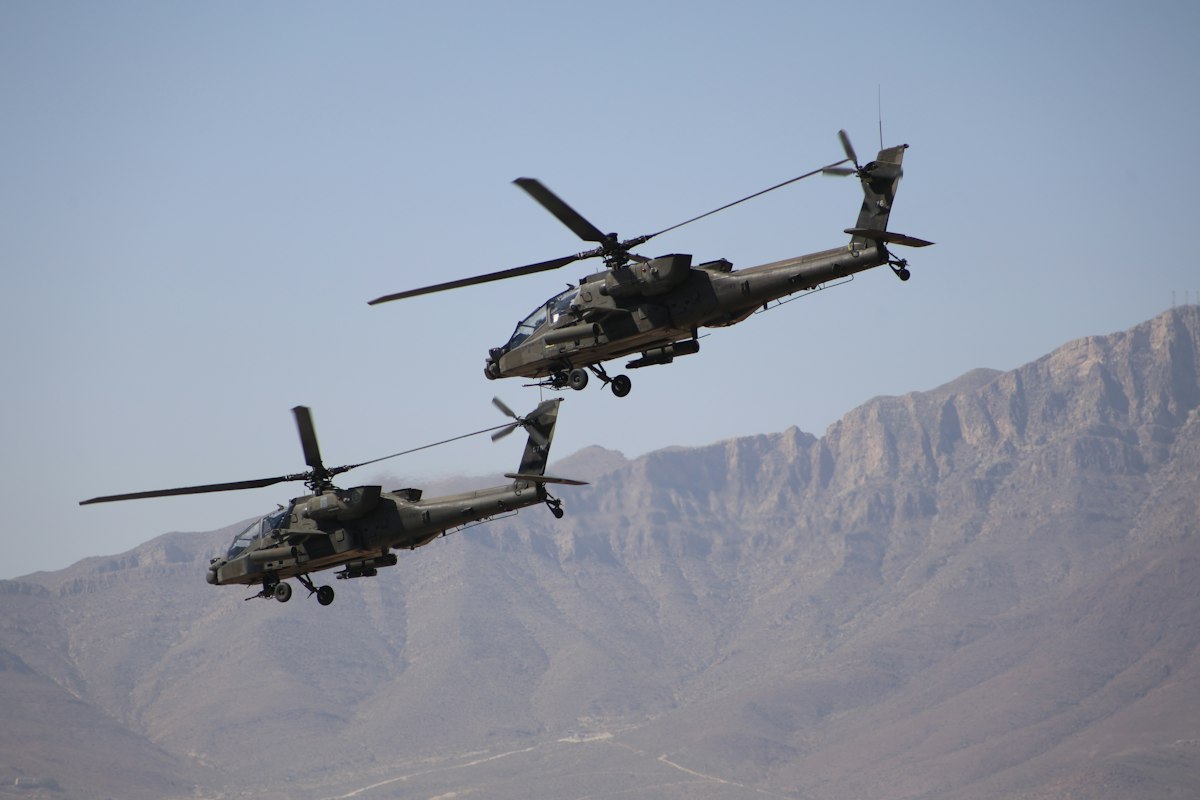
Anduril and Archer have unveiled Thunder at Farnborough, a Group 5 autonomous attack rotorcraft designed to fly beside the Apache. It carries ten Hellfires, cruises past 200 knots and folds into a shipping container. The economics of army aviation may never recover.
By Blumefield | 21 July 2026
The Aircraft Nobody Expected From an Air Taxi Company
Farnborough is where aerospace goes to make promises, and most of them are incremental. On Monday the pattern broke. Anduril and Archer Aviation pulled the covers off Thunder, an autonomous attack rotorcraft built on a jointly developed hybrid-electric tiltrotor platform, and in doing so revealed that the most consequential new combat aircraft in a decade emerged from a partnership between a defence software company and a firm best known for trying to build air taxis.
The provenance is the story. Archer spent years and a great deal of investor capital learning to design, certify and fly electric vertical takeoff aircraft for a commercial market that has never quite materialised at scale. Anduril spent the same period arguing that military hardware should be built like consumer technology, iterated fast and produced in volume. Thunder is what happens when those two theses collide. According to the announcement filed with Archer's investors, the aircraft is a clean sheet design rather than a militarised derivative, though it draws directly on the propulsion and rotor engineering that Archer's Midnight programme produced.
Adam Goldstein, Archer's founder and chief executive, was blunt about why the team did not simply adapt existing airframes. The mission, he said, required starting from first principles. Shane Arnott, who runs Anduril's Maneuver Dominance division, framed it commercially rather than technically, pointing to producibility as much as raw performance. Both men are describing the same bet: that the cost curve of commercial electric aviation can be imported wholesale into defence procurement, where unit economics have moved in exactly the wrong direction for forty years.
What Thunder Carries and Why It Matters
The specifications published around the unveiling explain the industry's reaction. Thunder is a Group 5 platform, the heaviest class of uncrewed aircraft, configured to carry up to ten Hellfire missiles, sixteen air-launched effects or seventy-six rockets, with counter-drone systems mounted in the nose. It is designed to cruise beyond 200 knots, which is the number that actually matters, because it means the aircraft can hold formation with an AH-64 Apache rather than trailing behind it.
That last detail reframes the entire category. Most uncrewed systems fielded over the past decade have been slower, shorter-legged and effectively separate from crewed formations. An autonomous attack rotorcraft that keeps pace with the manned aircraft it supports is a different proposition, because it can absorb the missions that get pilots killed. Low-altitude ingress into contested airspace is the most dangerous work in army aviation, and Ukraine has spent three years demonstrating how quickly cheap air defence turns helicopters into casualties.
The dual tiltrotor configuration varies rotor speed across flight regimes, which reduces fuel burn in cruise and, more importantly, cuts the acoustic signature during low-altitude approach. Anduril also says the aircraft breaks down to fit inside a standard forty-foot shipping container, a logistics claim that matters enormously for Pacific dispersal concepts and for NATO's High North planning. Multiple test flights with full-scale surrogate aircraft are already complete. Thunder's own first flight is targeted for 2027, with initial production of the autonomous attack rotorcraft running at roughly fifty units a year.
Lattice and the Autonomy Question
The airframe is impressive. The software is what makes it an autonomous attack rotorcraft rather than a very expensive drone. Thunder's flight behaviour runs on Anduril's Lattice for Mission Autonomy, which manages formation keeping, separation and flight logic so the aircraft behaves predictably around crewed platforms. Onboard sensors feed computer vision and edge compute that let it recognise terrain, avoid obstacles and continue operating when communications or satellite navigation are denied.
That last capability is the one worth dwelling on. An aircraft that keeps flying its mission after the link drops is, by definition, an aircraft making decisions without a human in the loop for some portion of its sortie. Anduril's framing is that Lattice handles airmanship rather than lethality, and that weapons release remains a human decision. That distinction is real and it is also thinner than it sounds, because the gap between navigating autonomously and engaging autonomously is a software configuration rather than a hardware limit.
Anduril has been unusually candid that its architecture is designed to scale toward higher autonomy as doctrine permits. Investors have priced that trajectory accordingly. As Blumefield has tracked across a run of defence technology raises this year, from Helsing's €1.8 billion round in Europe to Shield AI's $12.7 billion valuation, capital is flowing into military autonomy faster than into almost any other applied AI category. Thunder is what that money buys.
The Dual-Use Bargain
The commercial variant is the quiet half of the announcement, and Archer says it will name first commercial partners within days. The structure is deliberate. Electric vertical lift has struggled for years to close a business case on passenger economics alone, because certification is slow, batteries are heavy and the addressable market remains speculative. Defence budgets have none of those constraints. They are large, politically durable and relatively insulated from the venture cycle.
Building one platform that serves both markets lets military procurement subsidise commercial development, and lets commercial manufacturing volume drive down military unit cost. It is an elegant arrangement and it is also how a generation of aerospace companies became inseparable from national security policy. Archer shareholders now own exposure to an armed aircraft whether or not that was the thesis they underwrote. An autonomous attack rotorcraft was not in the original air taxi pitch deck.
For the broader sector, the read-through is that the boundary between commercial and defence aviation engineering has effectively dissolved. The perception stack, the edge compute, the battery chemistry and the flight control software are the same problems whether the payload is a passenger or a Hellfire. Talent moves freely between them. So, increasingly, does capital.
The Rules Are Not Keeping Pace
Here is the uncomfortable part. Washington spent this month finalising a voluntary framework that would give federal agencies up to thirty days to review frontier language models for national security implications before public release. That framework, expected to be announced before August, covers chatbots. It does not cover an autonomous attack rotorcraft carrying ten missiles.
The governance asymmetry is stark and rarely discussed. Enormous regulatory attention now attaches to text generation systems, while armed autonomous aircraft are governed by a separate and considerably slower international process that has produced no binding constraints. Anduril and Archer are operating entirely lawfully and transparently within that gap. The gap is the problem, not the companies exploiting it.
None of this makes Thunder a bad aircraft or the partnership a bad deal. Reducing pilot exposure in the most lethal flight profile in military aviation is a defensible goal, and the engineering behind the platform is genuinely novel. But an autonomous attack rotorcraft entering production around 2030 will outlive several administrations and any doctrine written today. The decision about how much judgement to delegate to Lattice will be made incrementally, by operators under pressure, long after the procurement debate has closed.
The unveiling at Farnborough was staged as an engineering milestone. It should be read as a policy deadline. First flight for the autonomous attack rotorcraft is 2027, which gives legislators roughly eighteen months to decide what rules apply to an aircraft that can find its own way home when the radio goes dead. On current evidence, they will not use them.