AMD's Quiet Bet on AI Inference Chips
AMD's newest bet is on AI inference chips, and it arrived without fanfare. On August 6, AMD confirmed it had signed a definitive agreement to buy Taalas, a three-year-old Toronto startup almost nobody outside the chip world had heard of. There was no price tag, no splashy product launch, and no on-stage demo. Yet the acquisition may prove one of the most consequential moves AMD has made in the artificial intelligence era, because Taalas builds a radically different kind of AI inference chips: silicon with the model itself baked directly into the transistors.
The logic is easy to miss under the corporate language. AMD framed the deal as a way to strengthen its "long-term AI roadmap with differentiated inference technology." Translated, it means AMD now owns a team that has proven you can etch a large language model into hardware and run it faster and far more cheaply than the general-purpose graphics processors that power almost every data center today. In a market where the cost of running models has become the defining constraint, that is not a footnote. It is a potential inflection point.
Inference, the business of actually running a trained model to answer a query, is where the money increasingly flows. AMD projects the segment could expand by more than 80 percent annually. Whoever controls the economics of inference controls the margins of the entire AI industry, and AMD just placed a bold, unconventional bet on how those economics will be won.
Hardwiring Intelligence Into Silicon
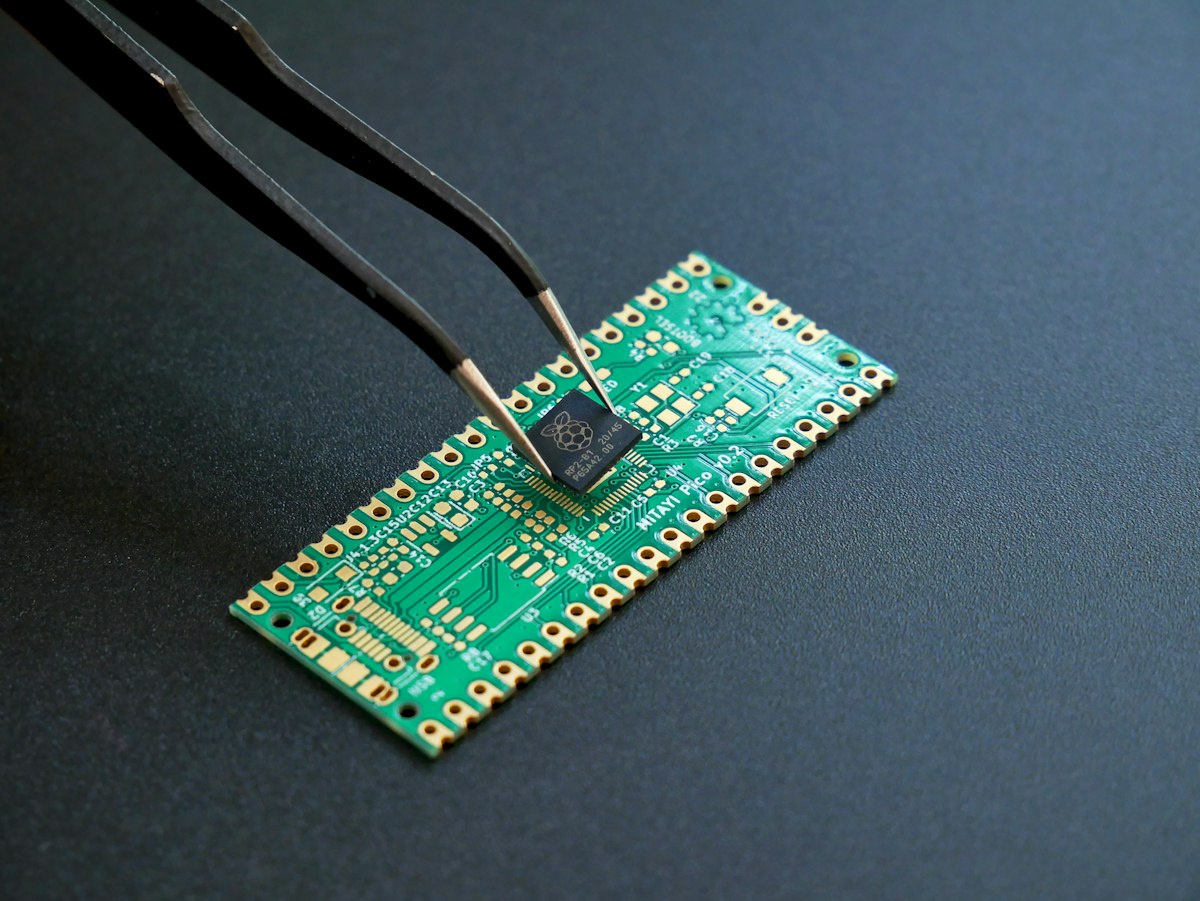
To understand why this matters, you have to understand what Taalas actually does. Most AI runs on chips like Nvidia's H200 or AMD's own Instinct accelerators, versatile processors that shuttle a model's billions of parameters back and forth between memory and compute cores. That constant movement of data, known in the industry as the memory wall, burns enormous amounts of power and time. Taalas sidesteps it entirely by hardwiring a model's weights permanently into the transistors themselves. The chip does not fetch the model. The chip is the model.
Founded in 2023 by Ljubisa Bajic, a veteran architect who worked at both AMD and Nvidia before co-founding the AI chip firm Tenstorrent, Taalas assembled a team of roughly 25 engineers drawn from Apple, Google, Nvidia and Tenstorrent. In February 2026 the company emerged with its first silicon, the HC1 Technology Demonstrator, tuned to run Meta's open-source Llama 3.1 model. Fabricated by TSMC on a mature 6-nanometer process, Taalas claimed the HC1 could generate more tokens per second per user than Nvidia's flagship parts and rival specialist chips from Groq, SambaNova and Cerebras, while drawing roughly one tenth of the power.
Perhaps the most striking detail is how little it cost to prove. The company reportedly built its demonstrator on around 30 million dollars of actual research spending, a rounding error next to the budgets of established silicon giants. That efficiency is exactly what attracted AMD, which is buying not just a technology but a philosophy: design the hardware around the model rather than forcing every model to conform to the hardware.
Why Inference Became the Battlefield
For most of the current AI boom, the story was about training. Building a frontier model demanded vast clusters of the most powerful chips, and that demand turned Nvidia into the most valuable company on earth. But training is a one-time event. Inference happens every single time a user asks a question, generates an image or runs an agent, and it happens billions of times a day. As adoption scales, inference is quietly becoming the larger and more permanent cost center.
This is why specialized AI inference chips have become the industry's next great prize. General-purpose graphics processors are extraordinarily capable, but that flexibility carries a tax in wasted power and silicon. When a company is serving the same handful of popular models to millions of users, the appeal of a chip purpose-built for exactly that workload becomes obvious. Lower power draw means lower electricity bills and less strain on the overtaxed grids feeding modern data centers. Higher throughput means more customers served per rack.
The race to build better AI inference chips is already crowded, and a wave of startups has attacked the problem from different angles. Groq bet on its own inference architecture, Cerebras on wafer-scale engines, and Etched on transformer-only silicon. Taalas represents the most extreme version of the idea, and by absorbing it, AMD signals that it views the inference layer as the terrain on which the next phase of the AI hardware war will be fought.
AMD's Full-Stack Gambit Against Nvidia
AMD has spent the past two years assembling the pieces of an alternative to Nvidia's near-total grip on AI computing. It has its Instinct line of accelerators, its EPYC server processors, its Helios rack-scale systems and its ROCm software stack, the open answer to Nvidia's proprietary CUDA ecosystem. What it has lacked is a differentiated weapon, something Nvidia does not already do better at greater scale. Taalas hands it a class of AI inference chips no rival can copy overnight.
The company says it will fold Taalas technology into its accelerator roadmap and build system-level products that pair the hardwired approach with Instinct graphics processors. The vision is a menu of options rather than a single hammer. Customers running fluid, experimental workloads can reach for flexible GPUs, while those serving fixed, high-volume models at massive scale can deploy the ultra-efficient AI inference chips that Taalas pioneered. Vamsi Boppana, who leads AMD's Artificial Intelligence Group, described the goal as giving customers "the flexibility to deploy the right compute solutions for every AI workload."
There is also a strategic subtext in geography. Taalas keeps AMD rooted in Canada, where the firm has long recruited engineering talent, and the deal was pitched partly as a commitment to retaining that talent base amid a global scramble for chip designers. For AMD, which reported strong second-quarter results just two days before announcing the acquisition, the timing reinforces a message to investors that it intends to compete on invention, not merely on price. You can read the full terms in the company's official announcement and its investor filing.
The Bet, and Its Fault Lines
No strategy this bold is free of risk, and the central tension in hardwiring models into silicon is obvious the moment you say it aloud. Models change. A chip etched to run one version of Llama cannot simply be updated when a better model arrives next quarter. The entire AI field moves at a punishing pace, and a physical chip cannot be patched the way software can. Taalas has argued that popular models stabilize once they reach production and stay in service for long stretches, which is when hardwired efficiency pays off. Whether that holds as the frontier keeps shifting is the question the whole bet rides on.
There are practical hurdles too. The deal remains subject to regulatory approvals, and manufacturing hardwired AI inference chips at volume is a different challenge from proving a single demonstrator. AMD will need to industrialize a boutique process, integrate a small team into a large organization, and convince cautious data center customers to trust an unfamiliar architecture with their most important workloads. History is littered with brilliant chip ideas that never survived contact with the realities of yield, cost and software support.
Still, the direction of travel is unmistakable. The AI industry is maturing from a phase defined by raw capability into one defined by cost and efficiency, and the companies that win the second phase may not be the ones that won the first. By betting on AI inference chips that treat a model as something to be cast in silicon rather than streamed through it, AMD is wagering that the future of artificial intelligence will be decided not by who can build the biggest model, but by who can run it for the least. For continuing analysis of the chip war reshaping technology, follow Blumefield and our ongoing coverage of the AI hardware race.