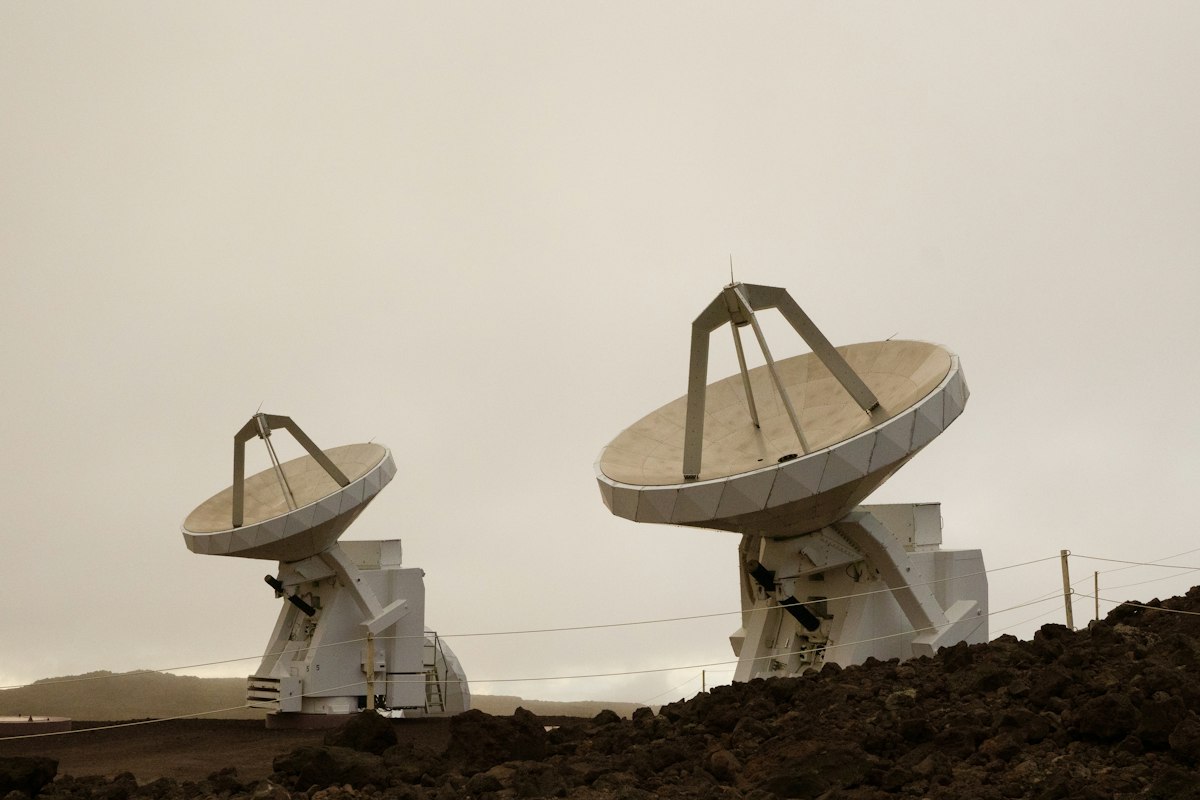
Satellite ground stations have become the quiet chokepoint of the space economy, and investors just put a $2 billion price on fixing them.
By Blumefield | November 3, 2026
Satellite Ground Stations Become the Space Boom's Bottleneck
The least glamorous link in the space business is quietly becoming the most contested. Every conversation about the space boom tends to fixate on two things, the rockets that go up and the satellites they carry. Almost nobody talks about the part that makes any of it useful, the network of satellite ground stations on Earth that actually receives the data and sends commands back. That blind spot is exactly where Northwood Space has planted its flag, and on Monday the Los Angeles company announced a $375 million Series C that values it at $2 billion.
The round was co-led by Andreessen Horowitz and DFJ Growth, with participation from Alpine Space Ventures, Washington Harbour Partners, Stepstone Activate and In-Q-Tel, the venture arm tied to the US intelligence community. Northwood also secured a multi-year credit facility from HSBC Innovation Banking. The raise pushes the firm's total funding past $500 million and marks one of the fastest valuation climbs in the space sector, arriving less than nine months after a $100 million Series B.
What makes the number striking is the unglamorous problem it targets. For decades, talking to a satellite has meant pointing a large parabolic dish at a single spacecraft as it passes overhead. As the number of objects in orbit explodes, that model is buckling. Satellite ground stations built for a few hundred satellites simply cannot keep pace with constellations that now number in the thousands.
From Disney to the Ground Segment
Northwood's chief executive, Bridgit Mendler, is an unlikely figure to be reshaping aerospace infrastructure. She spent her early career as a Disney Channel actress and singer before returning to what she calls her technical roots, earning a graduate degree at MIT. The company grew out of a pandemic-era project and her conviction that the ground needed its own transformation. Her husband and the company's chief technology officer, Griffin Cleverly, brought the deep space-systems background.
Mendler is blunt about the scale of the task. "Ground is a gnarly problem," she told Via Satellite earlier this year. Her argument is that launch costs and satellite manufacturing have both been revolutionized over the past fifteen years, while the ground segment was left behind. Satellite ground stations stayed expensive, slow to build and stubbornly bespoke. "There will continue to be exponentially more spacecraft going up into orbit," she said. "We're going to lose track of that if the ground systems are still ballooning in cost."
Her stated ambition is to make Earth-side capacity feel like a utility rather than a construction project. "We want ground to be like cloud in the sense where it is immediately available," she said, describing a world in which a satellite operator reserves a link the way a developer spins up a server.
Antennas That Ship Like Furniture
The technical bet behind the valuation is a phased-array system Northwood calls Portal. Instead of one giant dish tracking one satellite, a phased array uses a flat panel of many small elements that steer their beams electronically, letting a single installation talk to many satellites at once across low, medium and geostationary orbits. In testing last year, the company says Portal demonstrated a kilowatt of transmit power while receiving sub-picowatt signals on the same face at the same time, a combination it describes as novel.
The pitch is as much about logistics as physics. Northwood says one Portal can replace multiple traditional 7.3 meter dishes at a fraction of the cost and time, and that ten arrayed Portals can match the performance of a 20-foot dish. The hardware is modular and standardized, built to pack into shipping containers and switch on within hours of arriving. Mendler favors a furniture metaphor. "Our mental model is how can we go from the custom couch version of the world to the IKEA couch version of the world," she said. "Northwood is building the IKEA couches that you can ship out really easily and quickly."
Speed is the headline claim, and it is what lets Northwood treat its antennas as a product rather than a construction project. The company produced its first eight units in a four-week manufacturing sprint and says it stood up one site in roughly twelve hours. It now runs a 185,000 square foot factory in Torrance, California, and reports deployments across several countries, including Australia. A newer product line, a parabolic dish called Prism aimed at multi-gigabit links, extends the same ship-anywhere philosophy toward what the company likens to internet peering exchanges for space.
Why the Pentagon Came Knocking
The most telling validation did not come from a commercial operator but from the US military. In January, Northwood won a $49.8 million, three-year contract with the US Space Force to help upgrade its Satellite Control Network, the aging system that tracks spacecraft, including those maneuvering after launch or tumbling out of control after deployment. According to the company, the Space Force's Space Systems Command approached Northwood after a 2024 demonstration with Planet Labs, worried that the legacy network could not stay reactive as low Earth orbit fills with megaconstellations.
That defense interest explains the presence of In-Q-Tel on the cap table and hints at the strategic weight now attached to satellite ground stations. As Washington pushes proliferated constellations for missile tracking and resilient communications, the ability to command thousands of assets quickly, and to rebuild capacity if a site goes down, becomes a national security question rather than a commercial convenience. Resilient, rapidly deployable satellite ground stations are precisely what a distributed, hard-to-target architecture demands.
Northwood has been delivering links from geostationary satellites under the contract and operates mainly in the S-band and X-band frequencies used for telemetry, tracking and command. The dual-use nature of the business, serving both commercial constellations and government customers, sits at the center of the investment thesis.
The $2 Billion Question
For all the momentum, a $2 billion valuation on a company still early in its deployments carries obvious risk. Northwood is spending heavily to scale, and the broader space market has watched enthusiasm run ahead of revenue before. The ground segment is competitive, with incumbents and cloud giants already offering ground-station-as-a-service, and Northwood still has to prove its antennas perform at scale, in volume, across the harsh environments where satellite ground stations sit.
Mendler sounds undeterred, and her targets are expansive. "With the largest ground networks today, you have hundreds of sites, and so in terms of what is immediately in the horizon for us: we plan to reach that and surpass that," she told reporters on the Series C call. The proceeds, the company says, will go toward expanding the team and deploying antennas at more sites around the world.
The deeper thesis is that whoever standardizes the plumbing of the space economy captures enormous value, much as cloud providers did for computing. If satellites keep multiplying at the current rate, the firms that own these satellite ground stations may prove as indispensable as the ones that build the rockets. Northwood's backers are betting that the future of space runs through the ground. For more on the companies building that future, follow Blumefield and our ongoing technology and markets coverage.